Textile Recycling Is Scaling. Why Is Post-Consumer Integration Difficult?
Less Than 1% of Textiles Are Recycled Into New Clothes. Here’s Why That Statistic Is More Complicated Than It Looks
Every year, the fashion industry produces around 100 billion garments. Brands set ambitious recycling targets, and consumers fill donation bags. Billions of garments are collected globally, and yet less than 1% of post-consumer textiles make it back into new clothing. The circularity gap, despite years of commitment and investment, remains enormous.
The common assumption is that the technology is missing. At a lab or pilot level, it is not. Multiple recycling pathways exist today across multiple fibre types. But commercially viable processing at scale is a different story. The real bottleneck is that even existing technologies require very narrow, clean, and pure inputs: and the vast majority of real-world post-consumer waste does not qualify under current commercial conditions.
What Are the Different Methods of Textile Recycling?
Knowing the difference between the multiple recycling pathways is the first step to understanding why scaling is so hard.
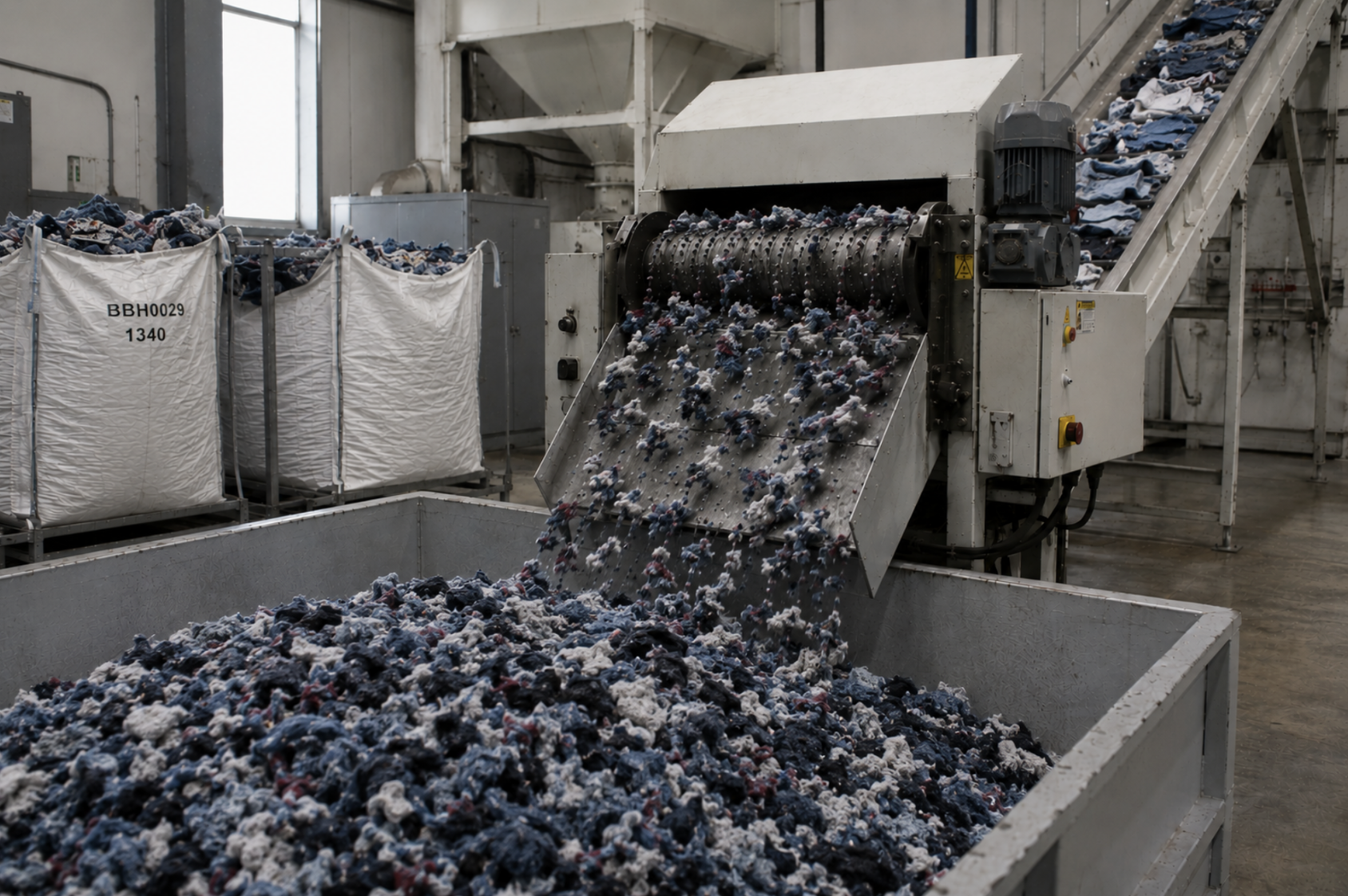
- Mechanical recycling is the most established method and the most widely used today. Fibres are shredded or pulled apart through physical processes, with no chemicals involved: low energy input, relatively high reward. The trade-off is quality: fibres degrade with each cycle, and output often needs blending with virgin material to meet industry standards. Because this process relies on physical rather than chemical transformation, it also demands the highest-quality input feedstock (typically mono-fibre materials such as 100% cotton, white or undyed textiles, or denim-only streams). Mixed or contaminated inputs yield poor output and are largely incompatible with the process.
- Innovators: Purfi, Säntis Textiles, Refibertech
- Thermomechanical recycling works by melting thermoplastic fibres – primarily polyester coming from textiles and bottles – and re-extruding them into new yarn. It preserves more of the polymer structure than mechanical recycling, but the process only works for specific thermoplastic fibres and demands near-pure input streams. Introduce blends or contaminants, and the process breaks down. Commercial capacity is growing
- Innovators: Unifi
- Chemical recycling comes in two distinct pathways. Compared to mechanical recycling, both can be colour agnostic and tolerate a lower blend threshold – making them better suited to the complex, mixed reality of post-consumer textile waste.:
- Monomer recycling breaks polymers all the way down to their molecular building blocks, producing virgin-like output quality across a wide range of fibre compositions, including cotton, polyester, and blends. It is more resource-intensive than other methods, but the quality ceiling is significantly higher.
- Innovators: Circ, CuRe Technology, BlockTexx, Depoly
- Dissolution recycling takes a different approach. Solvents are used to selectively dissolve specific fibre components without fully depolymerising them, preserving the polymer structure for reuse. It is particularly promising for separating blended fibres like polycotton, which most other methods struggle to handle.
- Innovators: Worn Again Technologies
- Monomer recycling breaks polymers all the way down to their molecular building blocks, producing virgin-like output quality across a wide range of fibre compositions, including cotton, polyester, and blends. It is more resource-intensive than other methods, but the quality ceiling is significantly higher.
- Enzymatic recycling is the newest frontier – like chemical monomer recycling, it breaks fibres down at a molecular level but uses biological enzymes rather than chemicals, making it potentially gentler and less energy intensive. The science is promising; the commercial readiness is not quite there yet.
- Innovators: Epoch Biodesign, Samsara Eco.
Each of these pathways carries its own input specifications, some more stringent than others. What they share is an incompatibility with the complexity of most post-consumer textile waste. With the exception of very specific, tightly defined material categories such as denim or white mono-fibre streams, real-world post-consumer waste rarely meets the consistency and purity required. At this stage of commercial scale-up, where economics are still being proven, every additional processing step adds cost, and that cost compounds quickly. At this stage of commercial scale-up, where prices directly impact uptake, every cost matters. And post-consumer textile waste, with all its complexity and variation, remains a difficult and expensive input for technologies that are still proving their economics.
Problem 1 – What Has to Happen Before Post-Consumer Textile Waste Can Be Recycled?
Feedstock preparation for recycling involves several steps to meet the technical specifications required, increasing the complexity and costs of using post-consumer textile waste
- Collection: Post-use, textiles are either separately collected or get mixed with general waste. The latter becomes unusable for any further processing.
- Sorting by rewearability: per the waste hierarchy, collected textiles should first be assessed for repair and resale, extending garment life with minimal processing. Only items deemed non-rewearable become candidates for recycling. Sorting for recycling: identifying the right compositions, colours, and other specifications for a recycler. While the waste ecosystem has largely relied on manual sorting (focused on resale), in order to meet the recycling demand, there has been development in automation with several commercial solutions available, but requiring heavy investments.
- Mechanical pre-processing: cutting, shredding, and trim removal; currently done mostly manually, Automated solutions exist but require heavy capital investment.
Sorters are hesitant to invest because the current recycling demand, which is limited, is still largely met by post-industrial waste – clean factory offcuts that require far less preparation. Commercial recycling capacities are projected to grow significantly in the next few years, which may improve demand for post-consumer material, but that future demand does not justify the infrastructure investment today. Sorters are stuck in a wait-and-see position. With many sorters reportedly selling/delaying their automation facilities (see Siptex and Circle8 in 2026).
Compounding this is a policy vacuum: regulatory support for this middle part of the chain – the sorting, pre-processing, and supply systems that sit upstream of recycling – remains limited and unclear, leaving the financial risk almost entirely with private actors.
Problem 2 – Sorted, Processed, and Still Rejected. What Makes Post-Consumer Waste Unfit for Recycling?
Recycling technologies are, by design, highly specific. Real-world post-consumer garments are, by design, anything but. Here is what makes most technically unfit for recycling:
- Fibre blends: Most recycling technologies do not want blends, or have high purity thresholds that leave a large section of waste unviable. Blends are common for utilitarian, economic and design purposes
- Elastane: even a 2 to 10% content, common in stretch fabrics, can disrupt or contaminate recycling processes entirely.
- Chemical and physical treatments: dye residues, functional coatings, laminates, and bonded seams (applied during production or accumulated through use) are difficult or impossible to remove without damaging the base material, and can compromise or entirely block downstream recycling processes.
- Complex garment construction – multi-layered materials and trims that cannot be easily removed, making disassembly either technically difficult or too costly at a commercial scale.
Feedstock that does not meet recyclers’ specifications gets rejected or downcycled, losing value entirely, and adding burden to the small portion that is in high demand. When material is called “unrecyclable,” it does not mean permanently impossible – it means not viable under current commercial conditions. That distinction matters because it points toward innovation and design as levers for change, not dead ends.
Even the waste that is technically recyclable faces a second barrier – the economics.
Problem 3 – The Economics of Post-Consumer Feedstock: Why the Numbers Don’t Work Yet
Even when post-consumer textile waste is deemed technically suitable for recycling, it incurs high sorting & processing costs, making feedstock too costly to make the business case work – creating a situation where producing recycled fibre costs more than simply sourcing virgin material. This is the paradox: the input that should, in theory, be low-cost waste becomes, in practice, an expensive and uncertain raw material, making the business case for T2T recycling difficult to sustain without external support. Post-consumer feedstock is expensive to collect, sort, and prepare – yet its valorisation through T2T recycling remains low.
- Feedstock costs can aggravate the T2T recycling pricing.
- Post-industrial waste dominates the current recycling supply because it is cheaper and easier. Recyclers who operate their own upstream production (for example, brands or manufacturers that generate their own post-industrial offcuts) prefer to work with that material because they have full visibility over its origin, composition, and quality, resulting in more predictable and higher-quality output. Post-consumer waste cannot compete with that level of consistency.
- Declining resale and export markets are squeezing sorter margins further, adding pressure to an already fragile business case.
- Recyclers taking blended or complex inputs often utilise the section they need, while leaving the non-focal portions waste– meaning they lose value mid-process on material they have already paid for.
The infrastructure investment needed to make post-consumer feedstock viable is not happening because the financial return is not there yet. It is a circular problem, and not the good kind.
What Needs to Change for Textile Recycling to Scale?
Making post-consumer textile waste a viable feedstock channel for recycling will require progress across three interconnected areas. None of these is sufficient on its own, and they need to move in parallel.
- Advanced pre-processing investment: automated sorting technologies are already available at commercial scale; the critical remaining unlock is advanced pre-processing technologies like fibre separation and elastane removal, which still need to move from pilot to commercial scale to make larger sections of post-consumer waste viable for recyclers, reducing the burden on high-demand sections as well as improving feedstock access (recycler perspective) and market access (sorter perspective).
- Regional hub models: co-locating sorting, mechanical pre-processing, and advanced pre-processing in centralised facilities could reduce per-unit costs and improve feedstock quality across the value chain; Fashion for Good is actively exploring regional hub models in Europe as part of Project FAE, with the goal of developing a practical blueprint that the wider industry can adopt.
- Policy and EPR: Extended Producer Responsibility schemes and clearer regulatory frameworks are needed to de-risk investment; ecomodulation within EPR frameworks – which rewards brands financially for designing products that are easier to recycle – is expected to be a key lever in gradually shifting garment design toward mono-materials, removable trims, and limited blends at source.
How Fashion for Good Is Tackling the Textile Feedstock Gap in Europe
Fashion for Good is directly addressing the feedstock gap through Project FAE (Feedstock Activation Europe). The initiative brings together major brands and industry players around a shared infrastructure challenge: making post-consumer textile waste a viable raw material for T2T recycling at scale.
FAE works across two tracks. The first assesses the technological and commercial feasibility of advanced pre-processing technologies that can solve for the complex and contaminated sections of post-consumer textile waste, such as through fibre blend separation, elastane removal, and contaminant extraction, to convert it into high-purity feedstock that can improve feedstock economics. The second develops a practical blueprint for regional hubs across Europe that can leverage aggregation and automation to process large volumes of post-consumer textile tailored to recycler specifications, with the objective of improving the business case for all value chain players. The goal is not just technical findings, but a commercial framework that the wider industry can act on.
Other Articles
Fashion for Good Launches The Cotton Reloop Matrix Project To Unlock Commercial Scale For Recycled Cotton

Wendy Woods Named Chair of the Fashion for Good BV Board