Resortecs

Resortecs produces a stitching thread which dissolves when exposed to heat for easy repair and recycling of garments. This allows for reduced water usage when compared to traditional disassembly and recycling processes used in closed-loop denim production, and the solution reduces textile waste through enabled ease of recycling. 
Indra Water

Resortecs produces a stitching thread which dissolves when exposed to heat for easy repair and recycling of garments. This allows for reduced water usage when compared to traditional disassembly and recycling processes used in closed-loop denim production, and the solution reduces textile waste through enabled ease of recycling. 
JSP Enviro

Resortecs produces a stitching thread which dissolves when exposed to heat for easy repair and recycling of garments. This allows for reduced water usage when compared to traditional disassembly and recycling processes used in closed-loop denim production, and the solution reduces textile waste through enabled ease of recycling. 

Dryfiber

Resortecs produces a stitching thread which dissolves when exposed to heat for easy repair and recycling of garments. This allows for reduced water usage when compared to traditional disassembly and recycling processes used in closed-loop denim production, and the solution reduces textile waste through enabled ease of recycling. 
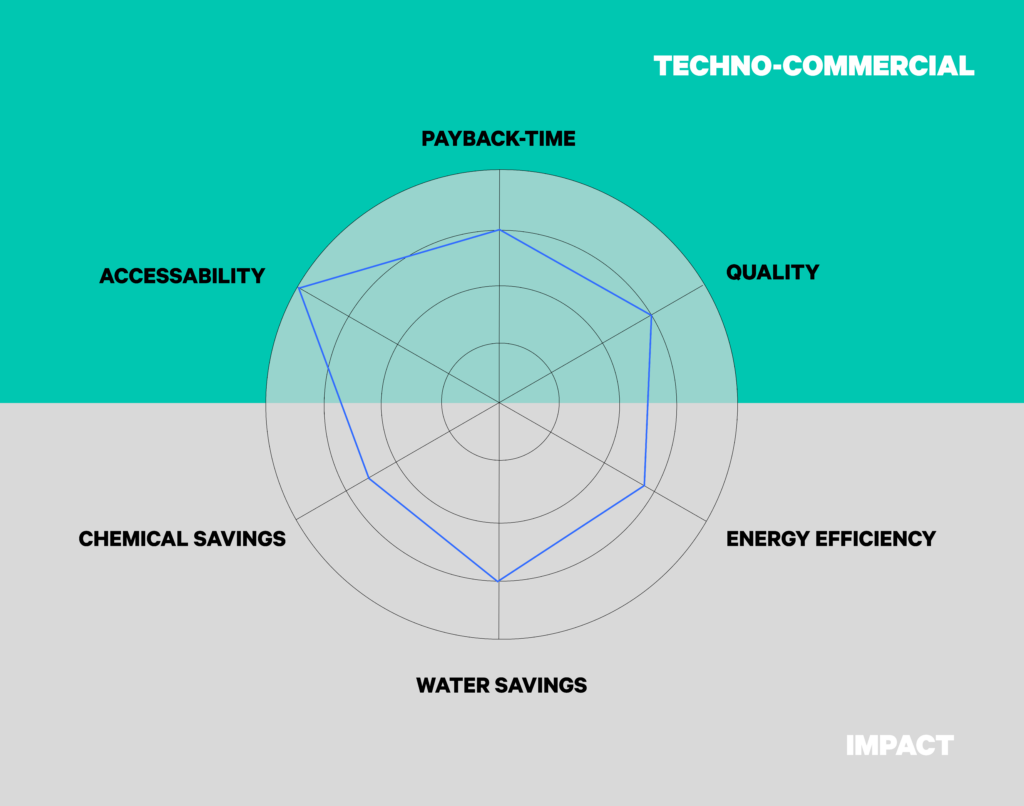
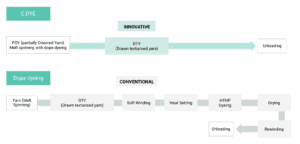
E.DYE

Resortecs produces a stitching thread which dissolves when exposed to heat for easy repair and recycling of garments. This allows for reduced water usage when compared to traditional disassembly and recycling processes used in closed-loop denim production, and the solution reduces textile waste through enabled ease of recycling. 
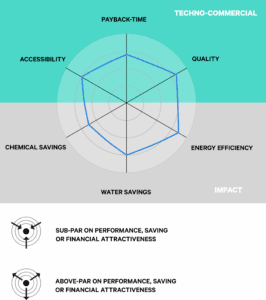
Technology

TRL: 9

E.DYE: Batch solution dyeing machinery

Step:

 Colouration

Application:

 Polyester

Key to their method is the use of master batch formulations, ensuring precise and consistent colour results. This approach aims to reduce environmental impact by conserving water and minimising chemical usage while enhancing manufacturing efficiency and product quality.

Savings

  • 100 %
    Water
  • 1.8 %
    Electricity
  • 42.7 %
    GHG*

Assessment Details

Substrate Tested:

 Polyester filament

Benchmarks:

 Commercial dope dyeing

Location:

China

Scope:

 Dyeing (Including dope dyeing spinning)

Scope

Results


Key Findings:

  • Big range of colours. 
  • Colour changeovers from one colour to another can impact costs and must be considered for process adoption. 
  • The system is more cost-effective with smaller vessels and requires dedicated machines for each colour range.
  • Particularly suited for technical, industrial, and non-woven textiles requiring large-scale dyed fibre or yarn production.
  • Does not require major modifications to existing fibre melt spinning machines but involves dedicated machines for specific colour ranges and slight adjustments to fibre extrusion setups.


Performance:
 Consistent colour and good reproducibility across multiple production runs, with minimal batch-to-batch variation. Precise colour matching.

Technology Maturity

  • LAB

  • DEMO

  • PRE INDUSTRIAL

  • INDUSTRIAL

Current Implementations

Countries: 2

Implementations: 2  (production sites)

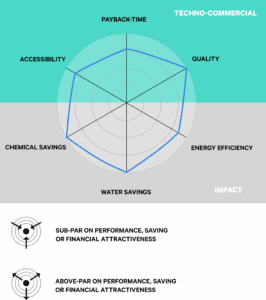
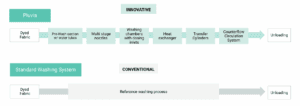
Pluvia

Resortecs produces a stitching thread which dissolves when exposed to heat for easy repair and recycling of garments. This allows for reduced water usage when compared to traditional disassembly and recycling processes used in closed-loop denim production, and the solution reduces textile waste through enabled ease of recycling. 

Technology

TRL: 9

Pluvia: Continuous low impact machine washing

Step:

 Washing

Application:

 All Fibres

 All constructions

Replacement for:

 Conventional CWR (continuous washing range)

Pluvia offers a continuous washing range (CWR) technology for post-dyeing and post-printing operations. It operates with a low-pressure system between the nozzle and the J-box, maintaining a low liquor ratio, working at low pressure and high volume, significantly enhancing the washing process and has low power consumption compared to other machines.

Savings

  • 92 %
    Electricity
  • 60 %
    Steam
  • 56 %
    GHG*

Assessment Details

Substrates tested:

Raw Material:

 Cotton

Construction:

 Knit

Benchmarks:

 CWR (Continuous washing range after dyeing) from Harish

 CWR (Continuous washing range after dyeing) from Erbatech

 Aii model non continuous washing system

Location: India

Scope:

 Dyeing & Washing (Including Steaming & fixation step)

Scope

Results

Key Findings:

  • The Pluvia continuous washing range has low power consumption.
  • Speed: 35-50  meters per minute (mpm) 
  • Streamlines dyeing and washing processes, reducing washing time by 3 hours and increasing capacity by 40% compared to the reference processes.
  • Machine speed and productivity varies depending on configuration, fabric construction, dyeing processes, and colors used. 


Performance:
Prevents fabric pilling and elongation, no performance related issues observed.

Technology Maturity

  • LAB

  • DEMO

  • PRE INDUSTRIAL

  • INDUSTRIAL

Current Implementations

Countries: 5

Implementations: 30

Zydex

Resortecs produces a stitching thread which dissolves when exposed to heat for easy repair and recycling of garments. This allows for reduced water usage when compared to traditional disassembly and recycling processes used in closed-loop denim production, and the solution reduces textile waste through enabled ease of recycling. 
Technology

TRL: 9

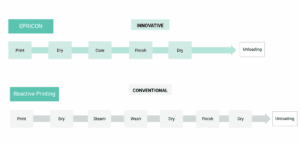
Epricon: Batch Printing pigment & binder system for print, dry and cure process

Step:

 Colouration

Application:

Raw Material:

 Cotton (all cellulosics and blends)

Construction:

 Knit

 Woven

Replacement for:

 Reactive printing

Zydex has developed Epricon, a printing system which utilises a distinctive co-polymer acrylic binder chemistry which reduces process energy demand. Epricon enables users to achieve depth, brightness, feel, and fastness equivalent to reactive printing systems, eliminating the necessity for washing and reducing the occurrence of rejected prints.

Savings

  • 12 %
    Water
  • - 28 %
    Electricity
  • 40 %
    Steam
  • 25 %
    GHG*

Assessment Details

Substrates Tested:

Raw Material:

 Cotton

Construction:

 Knit

Benchmarks:

 Reactive printing

Location: India, Sri Krishna spinning & weaving mills

Scope:

 Printing (Including Drying, Curing and Finishing steps)

Scope


Results

Key Findings:

  • Eliminates washing and steaming processes.
  • Improved penetration, reduced binder cracking, and enhanced durability on thicker substrates.
  • Provides savings in water, steam, greenhouse gas emissions, and processing time. However, higher thermic heat consumption is required for the curing process.
  • Integrates seamlessly with existing reactive printing facilities, enabling scalability. Designed for all-over screen printing, not suitable for digital printing applications


Performance: Very good. Using the ZYTROL 900 binder system, enhances the hand feel of the fabric which had comparable hand feel to the reactive printing system.

Technology Maturity

  • LAB

  • DEMO

  • PRE INDUSTRIAL

  • INDUSTRIAL

Current Implementations

Countries: 2

Baldwin

Resortecs produces a stitching thread which dissolves when exposed to heat for easy repair and recycling of garments. This allows for reduced water usage when compared to traditional disassembly and recycling processes used in closed-loop denim production, and the solution reduces textile waste through enabled ease of recycling. 
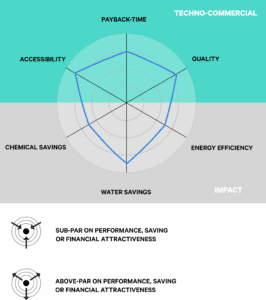
TRL: 9

TexCoat G4: Continuous spray finishing machinery

Step:

 Finishing

Application:

Raw Material:

 All Fibres

Construction:

 All Constructions

Replacement for:

 Traditional Foulard Finishing Systems

Baldwin’s TexCoat™ G4 is a precision spray finishing technology for textiles that utilises a non-contact application method.  The system employs a series of precisely spaced nozzles to apply chemicals or water evenly across the fabric. This approach allows for wet-on-wet and wet-on-dry applications. The system offers features like speed tracking, fabric-width compensation, and real-time monitoring of performance and chemical usage. 

Savings

  • 79 %
    Water
  • 51 %
    Electricity
  • 43.3 %
    Steam
  • 44.24 %
    GHG*

Assessment Details

Substrate Tested:

Raw Material:

 Cotton

Construction:

 Woven

Benchmarks:

 Traditional foulard process

Location: Italy, Tessitura Mariani

Scope:

 Finishing (including fixation and plasma pretreatment)  

Scope

Results


Key Findings:

  • Short deployment time and ease of integration, as modular design allows integration into existing stenters, improving energy efficiency.
  • Eliminates pad bath contamination and reduces changeovers, processes water-based chemicals, allows for single-side applications, and reduces drying times.
  • The system offers features like speed tracking, fabric-width compensation, and real-time monitoring of performance and chemical usage.
  • Supports both wet-on-wet and wet-on-dry applications.


Performance: Comparable to conventional process.

Technology Maturity

  • LAB

  • DEMO

  • PRE INDUSTRIAL

  • INDUSTRIAL

Current Implementations

Implemented: Globally

ACME

Resortecs produces a stitching thread which dissolves when exposed to heat for easy repair and recycling of garments. This allows for reduced water usage when compared to traditional disassembly and recycling processes used in closed-loop denim production, and the solution reduces textile waste through enabled ease of recycling. 

Technology

TRL: 9

ACME AM-ICD | Ultra low liquor ratio jet dyeing

Step:

Colouration


Application:

All fibres & constructions

Replacement for:

 Exhaust dyeing 

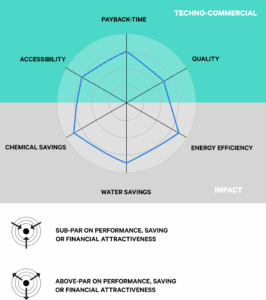
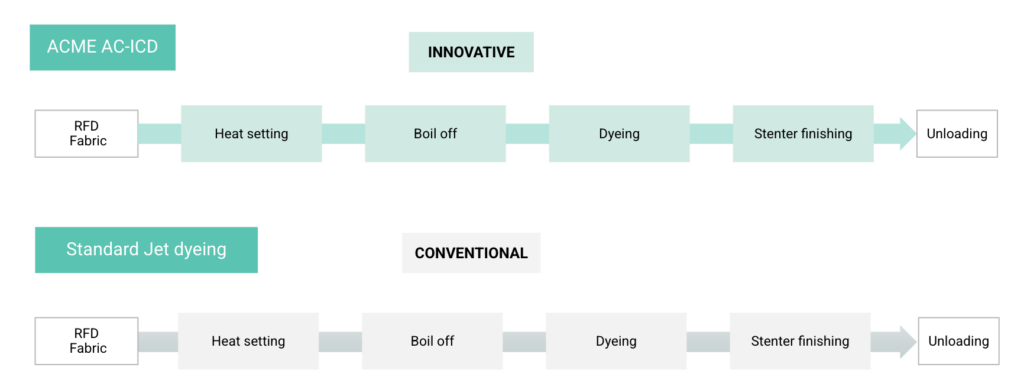
The ACME AM-ICD is a high-temperature, high-pressure (HT/HP) machine specifically engineered for the exhaust dyeing of fabrics. It features an Intelligent Conveyor Drive system for mechanical fabric transport, which replaces traditional hydraulic systems allowing an ultra-low liquor ratio.

Savings for PET

  • 56 %
    Water
  • 68 %
    Electricity
  • 41 %
    Steam
  • 18 %
    GHG*

Savings for Cotton

  • 67 %
    Water
  • 21 %
    Electricity
  • 33 %
    Steam
  • 45.6 %
    GHG*

Assessment Details

Substrate Tested:

Raw Material:

 Polyester & Cotton Fabric


Benchmarks:

 Exhaust process using jet dyeing machine

Location: TUNTEX textiles, Taiwan

Scope:

 Dyeing

Scope

Results

Key Findings:

  • Acme Dyeing Technology utilises an internal conveyor to physically transport the fabric, reducing the need for water, enabling dyeing at a very low liquor ratio of 1:2.5–1:3.5.
  • If only the dyeing step is considered (excluding heat setting, boil-off, and stenter processes) the savings are even higher, particularly in terms of GHG emissions, as thermal energy is mainly required for pre- and post-processing stages.
  • Reduced mechanical handling minimises friction, stretching, and surface abrasion, improving fabric quality.
  • A constant fabric speed is maintained, supporting uniform dye exhaustion and consistent batch quality, particularly in polyester processing.


Performance: 

  • The fabric showed high-quality performance, achieving repeatable results. 
  • Grey and black were selected as they are typically more challenging colours. The dyed fabric demonstrated good colour fastness, with values of 4-5.
  • The rubbing fastness achieved using ACME AM-ICD meets the quality standards of conventionally dyed fabric. 
  • No issues were observed regarding inconsistencies or the fabric’s handfeel.

Technology Maturity

  • LAB

  • DEMO

  • PRE INDUSTRIAL

  • INDUSTRIAL

Current Implementations

Countries: 20

Implementations: China, India, Bangladesh, Turkey, Vietnam, Indonesia, Korea, and Japan and more

Pulcra Chemicals

Resortecs produces a stitching thread which dissolves when exposed to heat for easy repair and recycling of garments. This allows for reduced water usage when compared to traditional disassembly and recycling processes used in closed-loop denim production, and the solution reduces textile waste through enabled ease of recycling. 
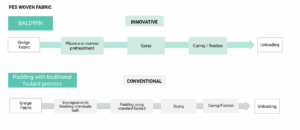
Technology

TRL: 9

Pulcra Breviol DNV

Step:

Pretreatment and colouration


Application:

Raw Material:

 Cotton


Replacement for:

 Traditional indigo slasher and rope dyeing chemical process

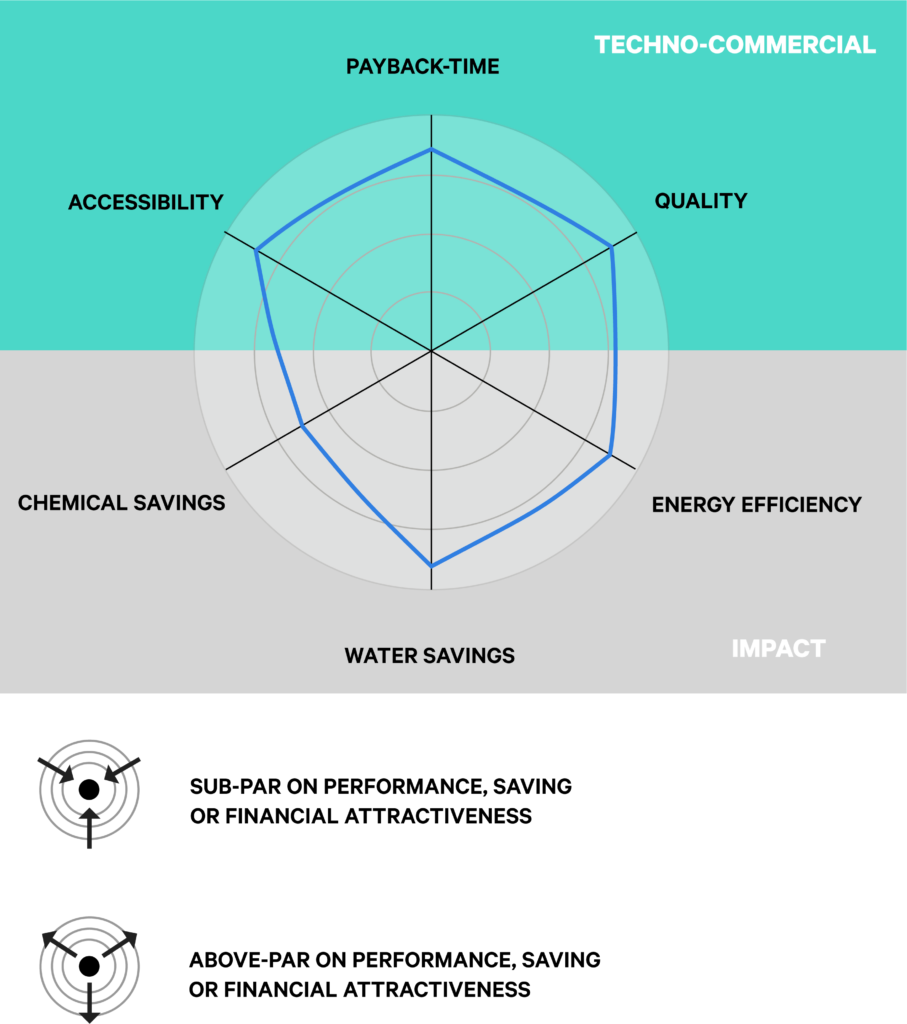
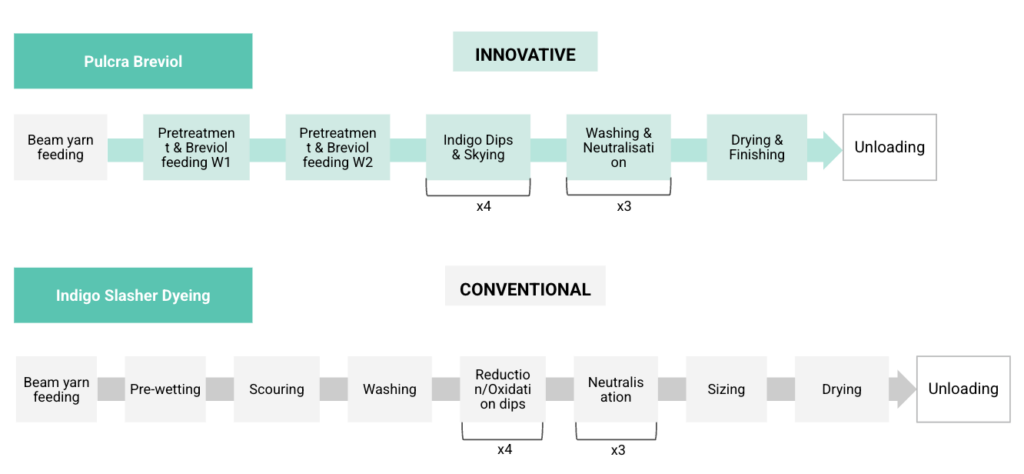
Pulcra Breviol DNV is a retrofit, low-water denim dyeing technology that enables indigo and sulphur dyeing on existing slasher ranges while eliminating traditional pre- and post-washing stages. By facilitating dye fixation in a single application step and enabling direct wet-on-wet sizing, it streamlines operations, reduces resource and chemical consumption, and minimises hazardous wastewater discharge.

Savings

  • 51.5 %
    Water
  • 30 %
    Electricity
  • 30 %
    Steam
  • 10 %
    GHG*

Assessment Details

Substrate Tested:

Raw Material:

 Cotton Yarn


Benchmarks:

 Commercial rope dyeing

Location: India

Scope:

 Dyeing

Scope

Results

Key Findings: 

  • Eliminating pre- and post-washing baths lowers total wastewater volume and prevents the release of unfixed dyes.
  • Lowering liquor and chemical consumption reduces the hydraulic and chemical burden on ETP and ZLD units, thereby cutting energy use and lowering the carbon footprint of wastewater treatment.
  • Achieves a 15% deeper shade under identical processing parameters; aligning with the benchmark depth enables a reduced consumption of indigo.
  • While overall chemical costs increase by 12.8% relative to conventional control dyeing, attaining a 15% darker shade allows matching the target shade with a 15% reduction in indigo costs, alongside a decrease in water usage. The combined financial gains from lower indigo and water consumption exceed 25%, fully offsetting the increased chemical expenses.


Performance:
 

  • DNV Achieves approximately 100% dye retention on yarn, preventing bronzing while producing darker shades and minimising back-staining and bleeding.
  • Rubbing fastness meets the quality parameters applicable to standard denim fabric requirements.
  • No concerns were identified regarding handfeel or process reproducibility.
  • Environmental and chemical compliance: Meets major industry standards and requirements, including REACH, OEKO-TEX, GOTS, ZDHC and bluesign.

Technology Maturity

  • LAB

  • DEMO

  • PRE INDUSTRIAL

  • INDUSTRIAL

Current Implementations

Countries: >10

Implementations: NA