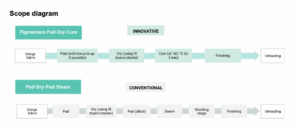
Pigmentura: A pigment-based continuous dyeing method that requires no water for the soaping and rinsing process steps.
Step:
Colouration
Application
All substrates (particularly suitable for cotton and cotton blends)
Replacement for:
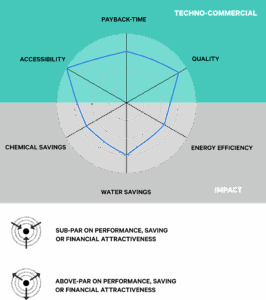
Pigmentura is CHT’s pigment-based dyeing technology that reduces water and energy use by eliminating soaping and rinsing steps, while delivering deep shades, improved fastness, and a smoother hand feel, particularly suited for cotton and cotton blends. The Pigmentura system combines water-based pigment dispersions (Bezaprint) with tailored auxiliaries that improve penetration, stability, fastness, and overall dyeing performance, enabling efficient pigment-based colouration.
Substrate Tested:
Raw Material:
Construction:
Benchmarks:
Pad-Dry-Pad-Steam (PDPS) process
Polyester part of blend dyed using disperse dye by thermosol method
Cotton part of blend dyed with reactive dye
Location: India / Pakistan
Scope:


Key Findings:
Adoption is still below 4% of the market and it is currently available only to CHT customers and their ecosystem. Scalability requires understanding of pigments and capacity building.
Performance: Pigmentura achieves comparable or improved fastness properties (dry and wet rub fastness; dry: 4 vs. 3–4, wet: 3–4 vs. 3 in PDPS) relative to PDPS, with less tailing and migration issues. It recreates reactive shades with good levelness and spectrum coverage, though fabrics may have a slightly harsher hand feel requiring softeners.
Countries: 8
Implementations: 25
Technology is deployed in 2-4% of continuous production facilities
https://apparelimpact.org/solutions/advanced-pigment-dyeing-system/

PLAtex: Plasma pretreatment
Step:
Pretreatment
Application
Raw Material:
Cotton
Construction:
Woven
Replacement for:
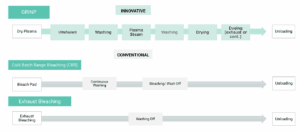
Traditional pretreatment systems
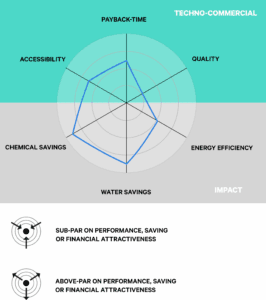
The PLAtex machine is a compact, modular, and eco-friendly plasma system that dry-functionalises textile fibres to enhance chemical absorption while drastically reducing water and chemical use.
Substrate Tested:
Raw Material:
Construction:
Benchmarks:
Location: Italy, GRINP facility
Scope:


Key Findings:
Performance: Problems with tensile strength when using dry on dry plasma. Some issues with lighter shades with regards to bleaching, work better on black/blue. Challenges with dyeing after the pretreatment, colour streaks and not good consistency.
Countries: 1
Implementations: 1 demo scale machine

India’s textile and apparel industry is at a critical inflection point. Contributing 2% to GDP and employing 45 million people, the sector faces mounting pressure from water scarcity, climate risks, and stringent global sustainability requirements. To meet the government’s US$100 billion export target by FY2031, the industry must achieve an ambitious 18% CAGR—demanding a rapid shift from resource-intensive processing to net-zero manufacturing. The Future Forward Factories India blueprint, initially developed in collaboration with Arvind limited, and later expanded into an open-source blueprint addresses this challenge through scalable strategic recommendations, with refined impact and cost modelling suitable for replication across India’s textile manufacturing ecosystem.
The apparel industry faces immense pressure to meet the 1.5°C target set by the Paris Agreement, with fashion accounting for 2-8% of global greenhouse gas emissions. Scope 3 emissions, especially from processing (Tier 2), represent a critical challenge. Shifting to dry processing technologies has the potential to reduce water and energy use, contributing to lower emissions and a smaller environmental footprint.
The D(R)YE Factory of the Future project brought together key industry leaders and innovators committed to revolutionizing textile processing. The project’s brand stakeholders included:
Initiated by Fashion for Good, Future Forward Factories focuses on transforming tier 2 processing in the textile industry through innovative low-impact, decarbonisation solutions. It aims to generate actionable blueprints for factories of the future that combine renewable energy and technology upgradation including mostly dry processing innovations. These blueprints take into account macro geographical factors, product customisations, and a lens of just transition to achieve near net-zero facilities that not only offer a strong return on investment, but are also inclusive and people-centric.
The open-source, modular blueprint for sustainable Tier-2 textile manufacturing is a forward-looking, industry-wide tool designed to accelerate adoption of next-generation sustainability practices. It enables manufacturers to build and implement near-net-zero factories by providing clear operational pathways, alongside economic viability and social impact analysis of advanced processes and solutions. By breaking complex technical recommendations into adaptable modules, the blueprint allows manufacturers of all scales to integrate improvements in a phased, practical way, aligned with globally benchmarked best practices and emerging regulatory standards. The project aims to cover 7 geographies by 2030.
The apparel industry faces immense pressure to meet the 1.5°C target set by the Paris Agreement, with fashion accounting for 2-8% of global greenhouse gas emissions. Scope 3 emissions, especially from processing (Tier 2), represent a critical challenge. Shifting to dry processing technologies has the potential to reduce water and energy use, contributing to lower emissions and a smaller environmental footprint.
The D(R)YE Factory of the Future project brought together key industry leaders and innovators committed to revolutionizing textile processing. The project’s brand stakeholders included: