WiseEye

WiseEye provides intelligent solutions for automating the inspection processes along the fashion and textile supply chain. They specialise in computer vision, image feature extraction, pattern recognition and deep learning technologies to automatically and instantly detect and grade the defects on woven and knitted textile materials, reducing loss and wastage due to faulty textiles by 90%.
T-Hues

WiseEye provides intelligent solutions for automating the inspection processes along the fashion and textile supply chain. They specialise in computer vision, image feature extraction, pattern recognition and deep learning technologies to automatically and instantly detect and grade the defects on woven and knitted textile materials, reducing loss and wastage due to faulty textiles by 90%.

Graviky Labs

WiseEye provides intelligent solutions for automating the inspection processes along the fashion and textile supply chain. They specialise in computer vision, image feature extraction, pattern recognition and deep learning technologies to automatically and instantly detect and grade the defects on woven and knitted textile materials, reducing loss and wastage due to faulty textiles by 90%.
WEKO

WiseEye provides intelligent solutions for automating the inspection processes along the fashion and textile supply chain. They specialise in computer vision, image feature extraction, pattern recognition and deep learning technologies to automatically and instantly detect and grade the defects on woven and knitted textile materials, reducing loss and wastage due to faulty textiles by 90%.
Rotaspray: Spray application system

TRL: 9

Step:

 Colouration

Application:

Raw Materials:

 Cotton

 Polyester

 Blends

Construction:

 Knit

 Woven

 Yarn


Replacements for:

 Standard lasher sulphur dyeing

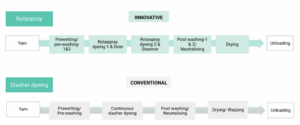
RotaSpray system enables precise, contactless dye and chemical application. It replaces traditional immersion-based methods (e.g. padding) with a more efficient and targeted approach. This reduces liquor contamination, improves flexibility in colour application, and eliminates unnecessary intermediate drying steps.

Savings

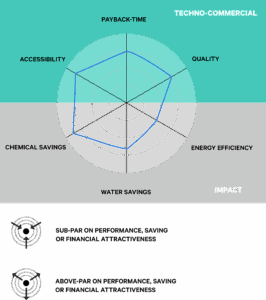
  • 0.4 %
    Water
  • - 65 %
    Electricity
  • 50.6 %
    Steam
  • 45.6 %
    GHG*

Assessment Details

Substrates Tested:

Raw Materials:

 Cotton Yarn

Benchmarks:

 Commercial rope dyeing

Location: India

Scope:

 Dyeing


Scope

Results

Key Findings:

  • Retrofit solution for existing slasher dyeing ranges, enabling integration without full equipment replacement.
  • Allows simultaneous application of indigo, sulphur, and vat dyes, improving efficiency for small-lot production and eliminates issues related to dye affinity and exhaustion when using dye mixtures.
  • Removes contamination risk between dye and chemical liquors.
  • Avoids hydrolysis of reactive dyes, improving fixation and reducing dye waste.
  • The intermediate drying (Brückner stenter) is the main driver of electricity consumption.
  • Reduces or eliminates salt usage, especially in bright shades.
  • Expands the range of achievable colours in continuous warp yarn and fabric dyeing.


Performance: The rubbing fastness in the yarn dyeing stage meets the quality parameter applicable to the standard denim slasher dyed yarns. Rotaspray dyeing process offers superior colour consistency, with all samples well within acceptable tolerance.

Technology Maturity

  • LAB

  • DEMO

  • PRE INDUSTRIAL

  • INDUSTRIAL

Current Implementations

Countries: 7

Implementations: 10

Weko® Spray finishing

TRL: 9

Step:

 Finishing

Application:

 All fibres and constructions  

Replacements for:

 Conventional pad finishing process

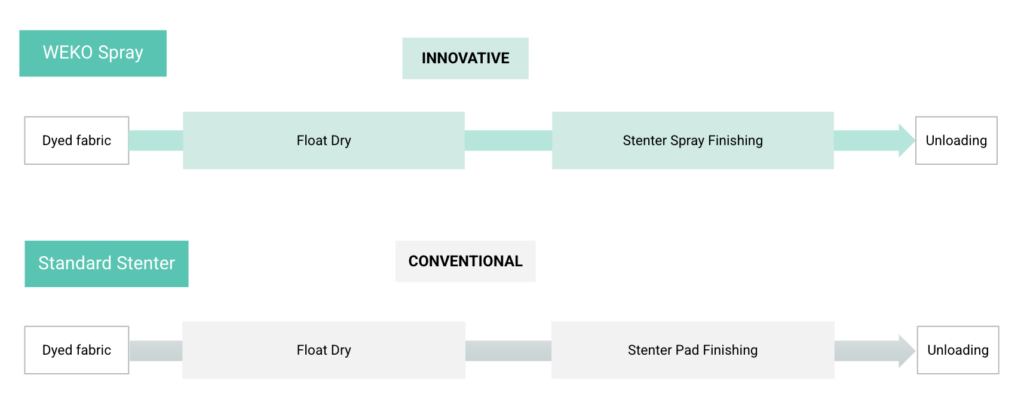
Weko® spray finishing is a non-contact, high-precision application system that uses rotating discs to create ultrafine droplets for uniform and reproducible chemical application on fabrics. Its modular design enables flexible single- or double-sided treatments while reducing water, chemical, and energy use. The system ensures consistent quality, prevents contamination, and supports high-speed, efficient textile finishing.

Savings

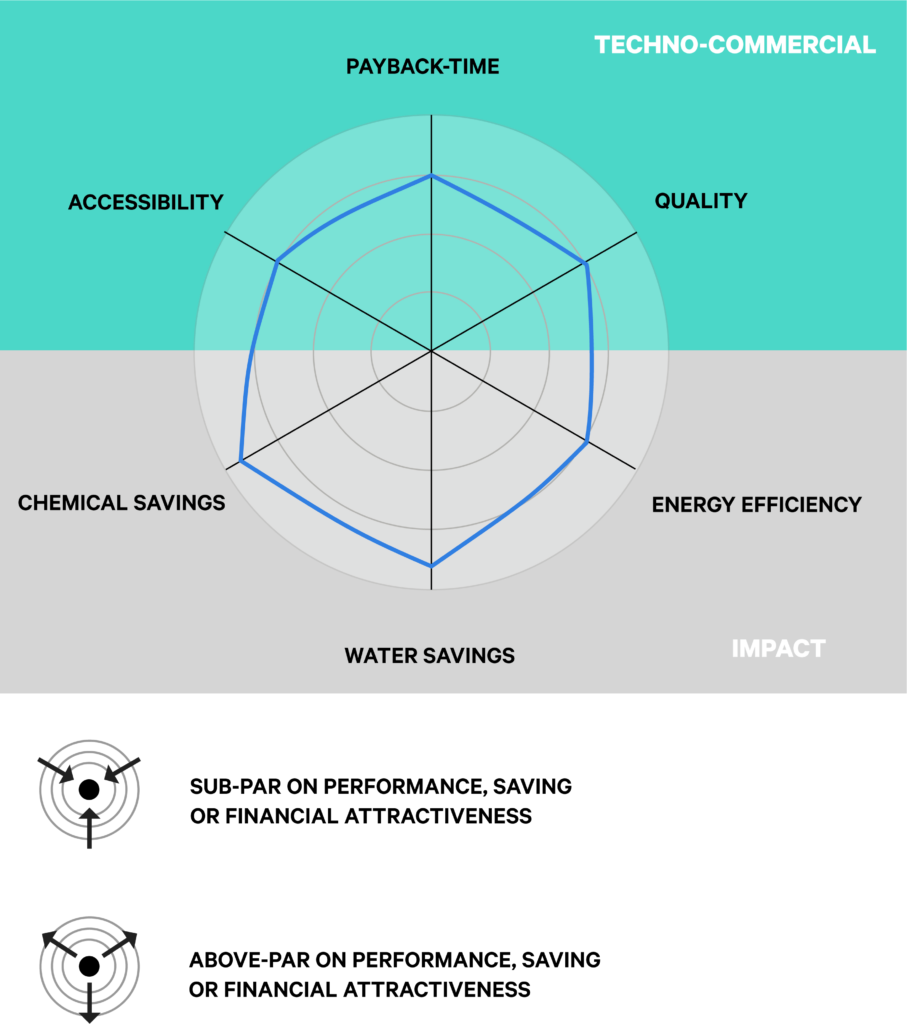
  • 28 %
    Water
  • 11.5 %
    Electricity
  • 4 %
    Steam
  • 7.5 %
    GHG*

Assessment Details

Substrates Tested:

Raw Materials:

 Polyester fabric

Benchmarks:

 Standard stenter padding process 

Location: GM Syntex, India

Scope:

 Finishing


Scope

Results

Key Findings:

  • Efficient dosing technology that delivers precise amounts (0.1 ml/m² or 0.1 g/m²) with liquid recirculation, minimising waste.
  • Contactless application ensures uniform chemical distribution and reduces the need for traditional padders and large dipping baths.
  • Achieves up to 43% reduction in chemical consumption and an 11% faster process.
  • Modular unit that can be retrofitted into existing stenter frames with no additional modifications required.
  • Caution required when using chemicals with high solid content; prior trials are recommended for applicability.


Performance: The water repellency durability of samples finished with the Weko® spray system was compared to conventionally finished samples. Weko®-finished samples showed a marginally smaller performance drop (after the 20th and 40th wash), well within the ±5% tolerance of the performance matrix.

Technology Maturity

  • LAB

  • DEMO

  • PRE INDUSTRIAL

  • INDUSTRIAL

Current Implementations

Countries: 5

Implementations: 5

RETHINK

WiseEye provides intelligent solutions for automating the inspection processes along the fashion and textile supply chain. They specialise in computer vision, image feature extraction, pattern recognition and deep learning technologies to automatically and instantly detect and grade the defects on woven and knitted textile materials, reducing loss and wastage due to faulty textiles by 90%.

Technology

TRL: 9

Sustendye® encapsulated dyeing technology.

Step:

 Colouration

Application:

 Cellulosics such as cotton and their blends

Replacements for:

 Conventional dyeing with reactive dyes

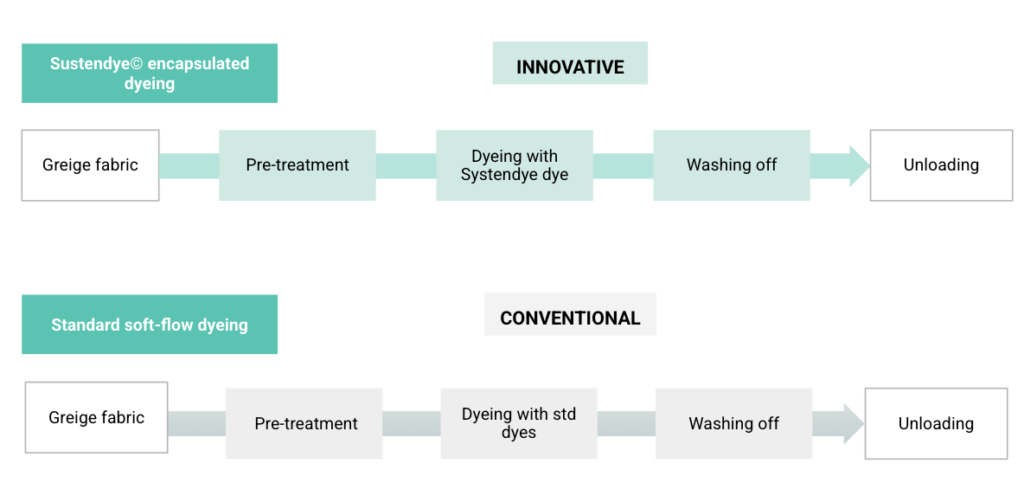
Sustendye is a molecular encapsulation process that enables dyes to deliver chemical components directly to targeted areas of the textile fibre. This protects the dye molecules during the exhaustion stage, increases fixation, and helps prevent premature hydrolysis or degradation in the dye bath.


Savings

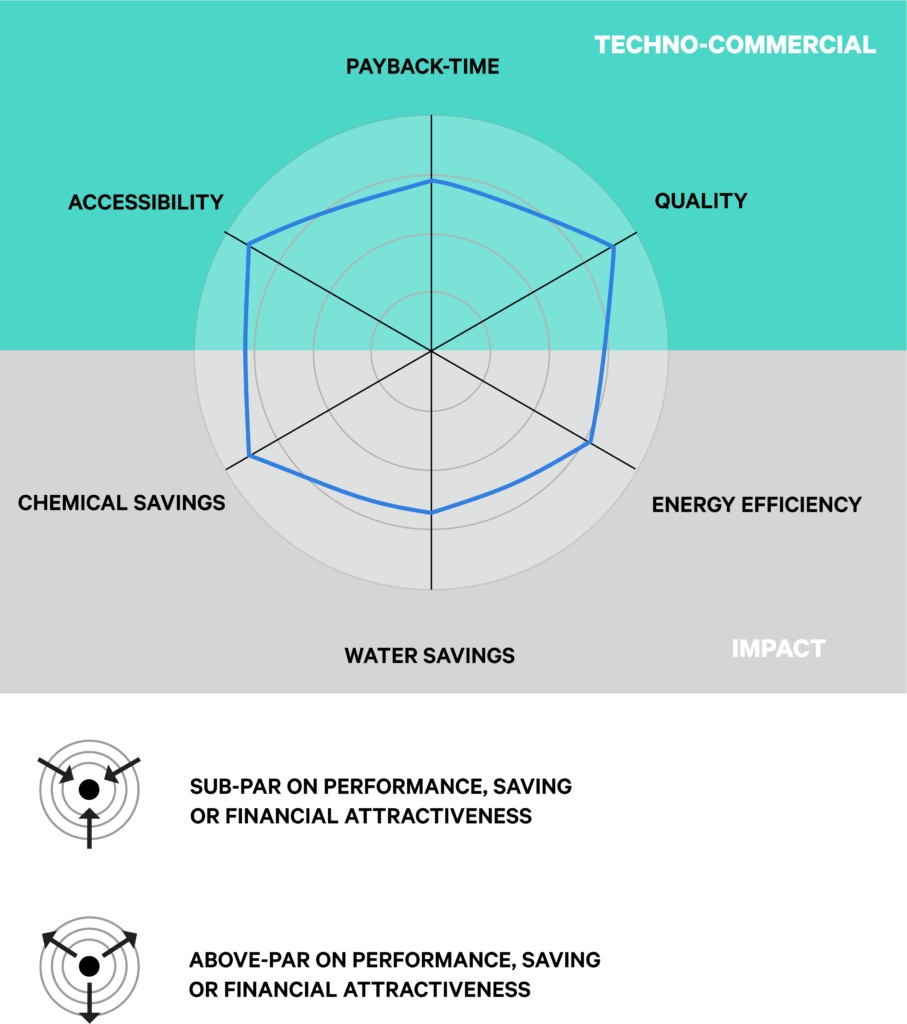
  • 40 %
    Water
  • 66 %
    Electricity
  • 74 %
    Steam
  • 68 %
    GHG*

Assessment Details

Substrates Tested:

Raw Materials:

 Cotton

Constructions:

 Knit

Benchmarks:

 Exhaust process using a soft-flow dyeing machine

Location: Honduras

Scope:

 Dyeing


Scope

Results

Key Findings:

  • 82% savings in salt usage (which is x5.2 times lower than the average conventional process). Lower salt consumption reduces treatment load for ZLD units and cuts the wastewater treatment CO2 footprint.
  • Liquid format reduces weighing errors and eliminates dust hazards found in powder dyes. Liquid dye format also simplifies Sustendye® handling and storage.
  • Shorter wash-off times increase machine capacity and output.
  • Compatible with existing exhaust dyeing setup.


Performance:

  • Sustendye® dyeing meets the required CF standards for washing, rubbing, and perspiration for standard dyed fabrics.
  • No noticeable inconsistencies observed across the fabric width, from the centre to the selvedge.
  • CF to water and to acid and alkali perspiration is good, with reduced wash-off requirements.
  • No loss of fabric strength  


Technology Maturity

  • LAB

  • DEMO

  • PRE INDUSTRIAL

  • INDUSTRIAL

Current Implementations

Countries: 4

Fully in production in 4 facilities

The availability of the technology is currently limited by the market reach of Rethink’s business coverage areas, although the company is in the process of expanding its market presence.

Deven Supercriticals

WiseEye provides intelligent solutions for automating the inspection processes along the fashion and textile supply chain. They specialise in computer vision, image feature extraction, pattern recognition and deep learning technologies to automatically and instantly detect and grade the defects on woven and knitted textile materials, reducing loss and wastage due to faulty textiles by 90%.
Technology

TRL: 7

SupraUno: Batch Solvent-based dyeing machinery using sCO2

Step:

 Colouration

Application:

Raw Materials:

 Cotton

 Polyester

 Blends

Construction:

 Knit

 Woven


Replacements for:

 Exhaust dyeing systems

 PDPS dyeing systems

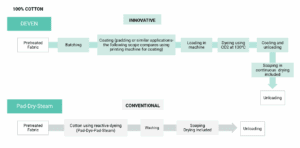
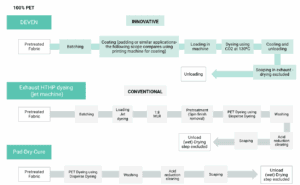
Deven’s patented technology, Suprauno, uses supercritical CO2 as a substrate for dyeing. ScCO2 at a correct pressure and adopts both liquid and gas properties so dye can solubilise in CO2 but then stay in the fabric when CO2 returns to its gas state. ScCO2 flows through a dyeing vessel that has pre-coated fabric and at about 200-300 bar pressure, >35 deg Celsius, the dye diffuses in the textile. 

Savings

  • 23 %
    Water
  • - 216 %
    Electricity
  • 27 %
    Steam
  • - 39 %
    GHG*

Assessment Details

Substrates Tested:

Raw Materials:

 Cotton 

 Polyester 

Constructions:

 Woven

Benchmarks:

 Exhaust dyeing (volume tested: 500 kg)

 PDPS dyeing for cotton and polyester (volume tested: 20,000 kg)

Location: India

Scope:

 Pretreatment

 Dyeing (Including Soaping & Drying)


Scope

Results

Key Findings:

  • Savings should be evident when dyeing blends as the machine is able to dye both fibre compositions (CO/PET) at once.
  • 35% less time needed for dyeing compared to exhaust or PDPS
  • High electricity consumption. Steam is reduced but there are still thermic heat requirements–mostly Liquefied Natural Gas (LNG)
  • Substantial water savings, especially when combined with continuous soaping or washing processes; highly suitable for water-scarce regions when integrated with ZLD or water treatment systems.
  • The current performance is based on lab trials; industrial implementation may yield different results, necessitating reassessment upon scaling.


Performance: Excellent quality, comparable to conventional. Good reproducibility demonstrated at lab scale. 

Technology Maturity

  • LAB

  • DEMO

  • PRE INDUSTRIAL

  • INDUSTRIAL

Current Implementations

Countries: 1

Implementations: 1 demo scale, 1 industrial (under implementation)

Demeta Solutions

WiseEye provides intelligent solutions for automating the inspection processes along the fashion and textile supply chain. They specialise in computer vision, image feature extraction, pattern recognition and deep learning technologies to automatically and instantly detect and grade the defects on woven and knitted textile materials, reducing loss and wastage due to faulty textiles by 90%.
D(R)YE Factory of the Future

Fashion for Good launched D(R)YE Factory of the Future in January 2022 in collaboration with brand partners Kering, adidas, PVH Corp. and manufacturing partners Arvind Limited and Welspun India with the aim of validating the most promising technology combinations in pretreatment and colouration processing steps to support the widespread adoption of mostly waterless innovations within the textile industry.

Problem Statement

The apparel industry faces immense pressure to meet the 1.5°C target set by the Paris Agreement, with fashion accounting for 2-8% of global greenhouse gas emissions. Scope 3 emissions, especially from processing (Tier 2), represent a critical challenge. Shifting to dry processing technologies has the potential to reduce water and energy use, contributing to lower emissions and a smaller environmental footprint.

Stakeholders involved

The D(R)YE Factory of the Future project brought together key industry leaders and innovators committed to revolutionizing textile processing. The project’s brand stakeholders included:

Aquaporin

Fashion for Good launched D(R)YE Factory of the Future in January 2022 in collaboration with brand partners Kering, adidas, PVH Corp. and manufacturing partners Arvind Limited and Welspun India with the aim of validating the most promising technology combinations in pretreatment and colouration processing steps to support the widespread adoption of mostly waterless innovations within the textile industry.

Stony Creek Colors

Fashion for Good launched D(R)YE Factory of the Future in January 2022 in collaboration with brand partners Kering, adidas, PVH Corp. and manufacturing partners Arvind Limited and Welspun India with the aim of validating the most promising technology combinations in pretreatment and colouration processing steps to support the widespread adoption of mostly waterless innovations within the textile industry.