
Demonstrator
Decarbonising textile processing cannot be achieved through individual technologies alone. It requires end-to-end implementation in real factories, where multiple innovations must operate together under production constraints, commercial timelines, and regional infrastructure realities. Demonstrator facilities play a critical role in bridging this gap — translating validated technologies into integrated, operating factories that generate the technical, financial, and operational evidence needed for scale.
Proving the pathway from blueprint to scale
Future Forward Factories uses demonstrators as system-level proof points: real Tier 2 facilities that show how near-net-zero textile processing can work in practice, across different geographies, energy systems, and manufacturing contexts.
The first Future Forward Factory blueprint has been developed in India, with 93% emissions reduction. This will be operationalised by Arvind as the lead demonstrator facility- which will serve as the North Star for other factories in India to retrofit their manufacturing using the blueprint.
Each blueprint in a new geography is intended to be operationalised by a strategic manufacturer demonstrator facility- a new build or rebuild facility which serves as a reference factory that suppliers, brands, financiers, and policymakers can point to as a credible model for future investment.
The Scaling Challenge
While the technologies used in Future Forward Factories have been validated individually, scaling them as an integrated system presents industry-wide challenges:
-
First-of-a-kind cost premiums when multiple innovations are deployed together
-
Perceived risk from manufacturers and financiers due to lack of integrated precedents
-
Fragmented capital stacks, where private, public, and philanthropic finance do not naturally align
-
Limited data on interoperability, operational performance, and cost trajectories at scale
Future Forward Factories addresses the industry’s scaling challenges through the process of building and operationalising demonstrator facilities on the ground. By deploying integrated technology stacks in real factories, the initiative absorbs early integration risk and generates the technical, financial, and operational evidence needed to support bankability. In parallel, FFF is structuring financing approaches that crowd in private and public capital around catalytic contributions, while enabling modular adoption of blueprint components in existing facilities to accelerate learning and replication. These efforts are designed to bend the cost curve, reduce uncertainty, and establish low-impact textile processing as a repeatable and investable standard for the industry.
Other Projects
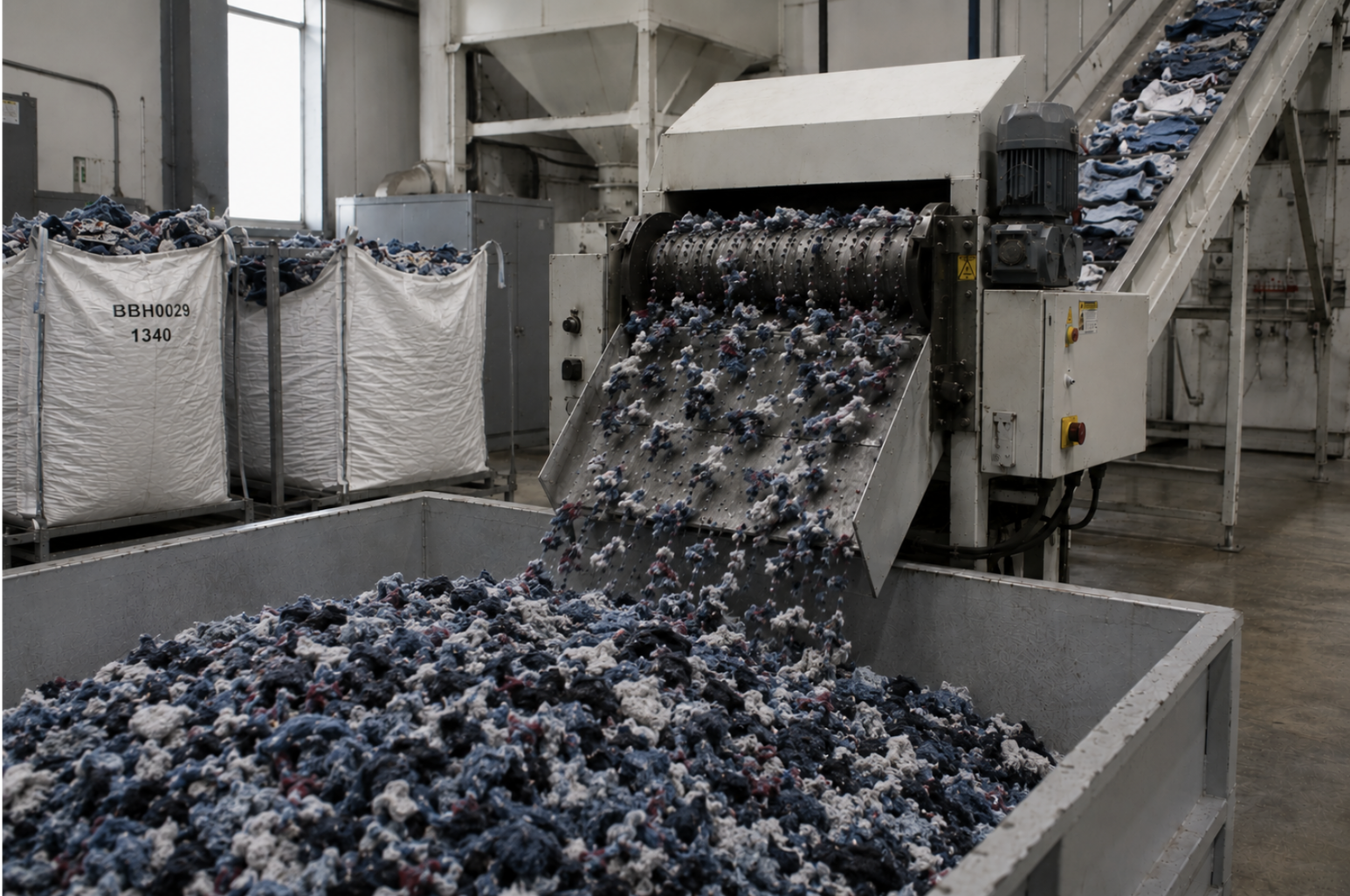
Cotton Reloop Matrix
The Cotton Reloop Matrix Project maps and validates what mechanically recycled cotton fibre and yarn can currently deliver against real-world brand specifications, while collaborating with the supply chain to establish a Standard Operating Procedure (SOP) for handling and processing recycled fibres, building the shared, objective view needed to close that gap.

DW(O)R-X
Durable water- and oil-repellent repellency (DW(O)R) finishes are chemical treatments applied to textiles and footwear to keep materials dry, clean, breathable, and durable. Historically, these finishes have relied on per- and polyfluoroalkyl substances (PFAS). However, PFAS are highly persistent, accumulate in the environment and in human bodies, and are associated with harmful health and ecological effects. Increasing regulatory restrictions, combined with brand sustainability commitments and rising consumer awareness, are accelerating the shift toward PFAS-free alternatives.

Sorting for Circularity Rewear
Fashion for Good expanded its Sorting for Circularity framework to address the challenge of sorting for rewearable textiles to understand better their resale potential and the demand across the second-hand market. We launched an 18-month initiative in January 2024 in collaboration with Circle Economy, brand partners adidas, Inditex, Levi Strauss & Co. and Zalando to enhance the sorting of rewearable textiles using innovative AI technologies. The project seeks to improve garment recovery for resale, promoting circularity in the fashion industry.
