Retrofit Track
Fashion for Good, in collaboration with its industry partner, the Apparel Impact Institute (Aii), is offering implementation support through the Retrofit Track in India. This is a limited opportunity, under which only three shortlisted facilities will receive hands-on guidance to apply the blueprint in their operations.
Overview of the Retrofit Support Track
The Retrofit Support Track serves as the first practical application of the FFF Blueprint in India. The overarching objective is to validate and operationalise the blueprint, and showcase how the open-source blueprint can be effectively implemented in real-world settings.
The retrofit support is structured in three progressive stages—Supplier Selection, Technical & Financial Roadmap Development, and Adoption & Monitoring—implemented over approximately twelve months.
Suppliers are invited to register their interest through standardised intake form capturing key operational data, including production capacity, product type, machinery list, energy and water consumption baselines, and readiness to invest.
Then, using Aii’s industry benchmark assessment, each facility will be evaluated on climate risk, performance relative to peers (below, at par, or above industry standards), and alignment with the FFF product category.
A preliminary longlist will then be developed for on-ground assessments by a technical expert engaged by Fashion for Good and Aii. These assessments—combining site visits, data validation, and stakeholder interviews—will help finalize the top three suppliers for assisted implementation.
This selection process ensures that participating facilities represent a range of operational realities—medium to high capacity units capable of demonstrating scalable retrofits and enabling peer learning across India’s textile clusters.
For each selected supplier, a customized retrofit roadmap will be co-developed by Aii, FFG and the technical expert. This roadmap will build directly on the FFF blueprint’s technical scenarios and financial modeling frameworks, translating them into plant-specific action plans.
Technical Roadmap:
The technical roadmap will follow a stage-gated structure—from baseline to commissioning—covering:
- Stage 2.1: Baseline data validation and constraint mapping, including machinery condition, process flows, and utility infrastructure.
- Stage 2.2: Concept design and equipment specification, identifying technologies for replacement, integration, or optimization.
- Stage 2.3: Retrofit implementation plan, including installation sequence, and downtime management.
- Stage 2.4: Operator training, commissioning, and SOP handover to ensure sustained performance.
Financial Roadmap:
In parallel, a financial model will be developed to assess the feasibility of the proposed technical plan and identify any additional support required, which may be sourced from government subsidies or industry initiatives.
The financial structure will include:
- A basic financial analysis outlining the payback period, IRR, and NPV of the recommended scenario for each supplier.
- An assessment of the supplier’s financial capacity and potential funding needs, along with identification of available support mechanisms to build the overall financing stack. Such support may come from brand collaboration mechanisms (e.g., advance purchasing or volume guarantees), industry programmes (such as Aii’s Gap Funding or the FSI initiative), or government incentives (including Technology Upgradation Funds or energy-efficiency schemes).
Adoption:
Once the roadmaps are finalised, implementation support will begin. FFG and Aii will guide each supplier through the retrofit and commissioning phase, supported by operational partners. The operational support is applicable for 6 months.
Monitoring and Evaluation (M&E):
Environmental performance will be measured against baseline data using energy, water, and GHG emission indicators consistent with Aii’s benchmarking framework.
After the retrofit period, the collected data will feed back into the FFF Blueprint Tool, updating impact benchmarks and informing future iterations of the open-source document. This feedback loop ensures continuous improvement and scalability of the blueprint across regions and product types.
Knowledge Dissemination:
Results, insights, and implementation challenges through each retrofit case will be shared through reports to encourage further adoption. The long-term goal is to scale from three assisted retrofits to a larger portfolio of self-driven implementations by the manufacturer themselves.
Other Projects
Cotton Reloop Matrix
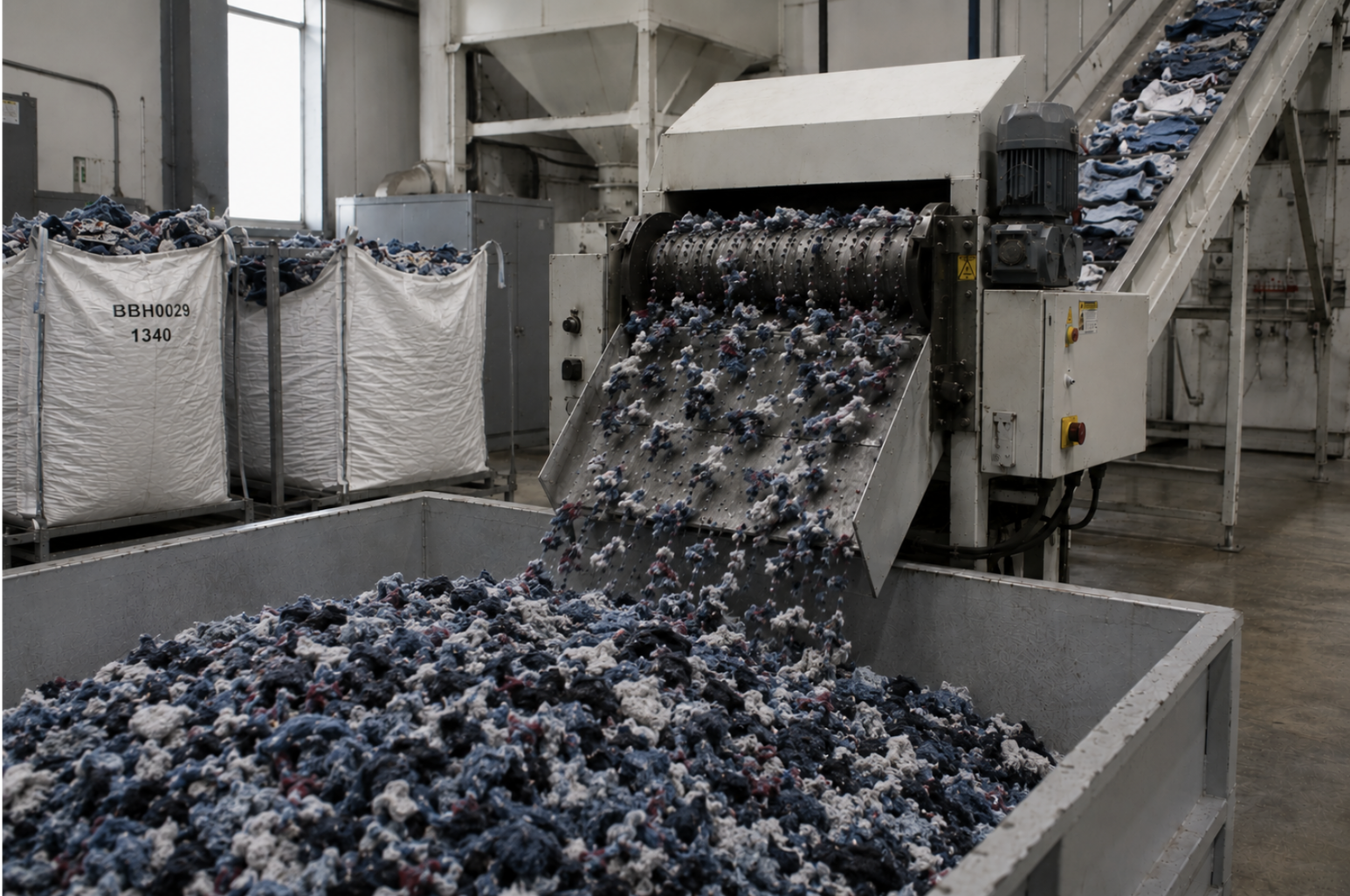
The Cotton Reloop Matrix Project maps and validates what mechanically recycled cotton fibre and yarn can currently deliver against real-world brand specifications, while collaborating with the supply chain to establish a Standard Operating Procedure (SOP) for handling and processing recycled fibres, building the shared, objective view needed to close that gap.

DW(O)R-X
Durable water- and oil-repellent repellency (DW(O)R) finishes are chemical treatments applied to textiles and footwear to keep materials dry, clean, breathable, and durable. Historically, these finishes have relied on per- and polyfluoroalkyl substances (PFAS). However, PFAS are highly persistent, accumulate in the environment and in human bodies, and are associated with harmful health and ecological effects. Increasing regulatory restrictions, combined with brand sustainability commitments and rising consumer awareness, are accelerating the shift toward PFAS-free alternatives.
Sorting for Circularity Rewear
Fashion for Good expanded its Sorting for Circularity framework to address the challenge of sorting for rewearable textiles to understand better their resale potential and the demand across the second-hand market. We launched an 18-month initiative in January 2024 in collaboration with Circle Economy, brand partners adidas, Inditex, Levi Strauss & Co. and Zalando to enhance the sorting of rewearable textiles using innovative AI technologies. The project seeks to improve garment recovery for resale, promoting circularity in the fashion industry.
