Cotton Reloop Matrix
The Cotton Reloop Matrix Project maps and validates what mechanically recycled cotton fibre and yarn can currently deliver against real-world brand specifications, while collaborating with the supply chain to establish a Standard Operating Procedure (SOP) for handling and processing recycled fibres, building the shared, objective view needed to close that gap.
What's the challenge?
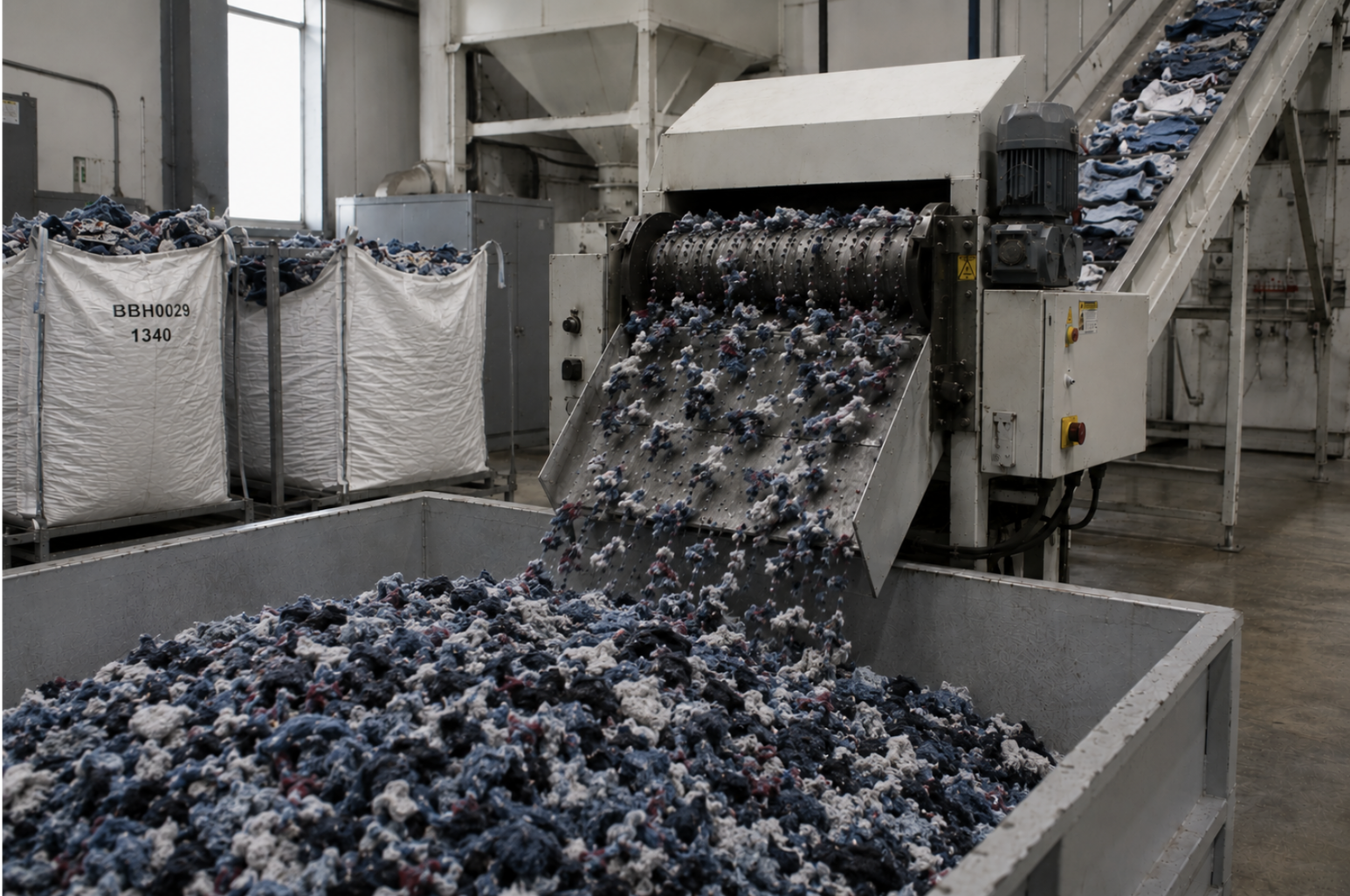
Cotton makes up 19% of global fibre production, yet at end of use, the fibre itself becomes part of the waste problem. Mechanical recycling, the most commercially available pathway, yields only 45–50% usable fibre, with the remainder lost as short fibres and processing waste. Recycled content beyond 10% can also compromise yarn strength, elongation and fabric durability, creating a performance ceiling. As a result, recyclers report available capacity, while brand adoption remains limited by concerns around material consistency, fibre length and price premiums, compounded by the lack of unified, objective quality benchmarks across the industry.
Executive Summary
Recycled cotton has the potential to close the loop on one of the fashion industry’s largest fibre categories, but brands, mills and recyclers currently operate without a shared, data-backed view of where quality, price and recycled content genuinely intersect. The Cotton Reloop Matrix Project sets out to close that gap.
Working with leading brands across knit and woven categories, Fashion for Good is mapping the global mechanical recycling and quality augmentation landscape and plotting it against brand quality ranges through a Quality Matrix. Selected recyclers will be physically validated through 10 demonstrator fabrics and 5 quality augmentation trials, generating a Trade-off Analysis that shows how recycled content, price and quality are linked. Best practices from these trials will be captured in a universal, open-source spinning SOP. The project closes with the Roadmap for Cotton Circularity, an industry-facing report setting out the data infrastructure needed to scale recycled cotton adoption across product categories and regions.
Goals of the Project
-
Align realistic brand quality targets with current recycled cotton capabilities across knit and woven categories to clarify price, performance, and recycled content trade-offs.
-
Develop a detailed overview of commercially viable solutions, encompassing integrated mechanical recycling technologies and pathways for quality augmentation.
-
Conduct due diligence on integrated recycling technologies and quality augmentation pathways across established players and innovators.
-
Develop an interactive decision-making tool and a universal operational guide (SOP) designed to support consistent manufacturing across global supply chains.
-
Produce 10 demonstrator fabrics and test 5 high-potential quality augmentation pathways in real-world mill conditions to physically validate performance and processing methods.
Innovation Partners



Advisory Partners


Ecosystem Partners
FAQs
What is mechanical recycling and why does the textile industry need shared quality standards for it?
Mechanical recycling shreds and re-opens textile waste into fibres for respinning. It is the most commercially available end-of-use pathway for cotton, but it typically yields only 45-50% usable fibre and degrades yarn quality beyond a 10% recycled content threshold. Without shared, objective benchmarks, brands have had to run isolated validation trials, which slows industry-wide adoption. The Cotton Reloop Matrix Project builds that shared reference point.
Why does recycled cotton quality degrade as recycled content increases?
Mechanical recycling shreds textile waste into fibres, which shortens and weakens them in the process. Once recycled content in a yarn goes beyond roughly 10%, this fibre shortening starts to reduce yarn strength, elongation and fabric durability, creating a performance ceiling that sits below standard commercial apparel specifications.
Why hasn't recycled cotton been scaled if recyclers have available capacity?
Recyclers report having idle capacity, but brand adoption remains limited by concerns over inconsistent material quality, fibre length and price premiums. Without shared data on how these factors interact, brands have continued to test in silos rather than working from a common picture. This project surfaces the actual capabilities and trade-offs of recycled fibres today. By providing transparent performance data, quality augmentation pathways and practical decision-making tools, it answers these open questions and creates a clear path to commercial adoption.
Relevant Resources

Stretching Circularity
The Stretching Circularity Project aims to accelerate the development and adoption of lower-impact elastane solutions for the apparel industry through two workstreams. One workstream focuses on testing next-generation elastane materials made from alternative inputs, including bio-based materials and other feedstocks. The other focuses on testing regenerated elastane made through emerging recycling innovations. Both workstreams follow a pilot-scale validation approach to generate comparable data on performance, impact, economic feasibility and scalability.

Beyond50 Denim: Combining Cottonised Hemp And Green Chemistry
“Beyond50 Denim: Combining Cottonised Hemp And Green Chemistry” aims to validate the performance and environmental impact of cottonised hemp processed with green chemistry to act as a true alternative to cotton in denim applications. The project goal is to evaluate the performance of SEFF’s cottonised hemp fibre in combination with Fibre52’s bio-friendly chemistry solution within denim fabric applications with a total hemp content of 50% and above. The fabrics will be benchmarked against conventional 100% cotton denim with a specific focus on handfeel and aesthetic characteristics.

Price Parity Toolkit
The Price Parity Toolkit (PPT) was designed to help bridge the price gap between next-gen* and conventional materials. This industry-supported framework, with catalytic funding from Laudes Foundation and developed by Fashion for Good with support from Canopy, Finance Earth and select brands and fibre producers, introduces a financing mechanism. This mechanism aims to decouple price premiums early in the supply chain, thereby enabling the adoption and scaling of lower-impact materials.

The Next Stride: Bio-based Materials for Footwear Soles
“The Next Stride: Bio-based Materials for Footwear Soles” aims to validate the performance and environmental impact of bio-based polymers as sustainable alternatives to the fossil fuel-derived materials currently used in footwear soles. The objective is to collectively de-risk the transition to these “next-generation” materials by rigorously testing their technical properties and assessing environmental benefits. Ultimately, the purpose is to accelerate the adoption of these bio-based solutions and pave the way for a more sustainable footwear industry.

DW(O)R-X
Durable water- and oil-repellent repellency (DW(O)R) finishes are chemical treatments applied to textiles and footwear to keep materials dry, clean, breathable, and durable. Historically, these finishes have relied on per- and polyfluoroalkyl substances (PFAS). However, PFAS are highly persistent, accumulate in the environment and in human bodies, and are associated with harmful health and ecological effects. Increasing regulatory restrictions, combined with brand sustainability commitments and rising consumer awareness, are accelerating the shift toward PFAS-free alternatives.
Other Projects
DW(O)R-X
Durable water- and oil-repellent repellency (DW(O)R) finishes are chemical treatments applied to textiles and footwear to keep materials dry, clean, breathable, and durable. Historically, these finishes have relied on per- and polyfluoroalkyl substances (PFAS). However, PFAS are highly persistent, accumulate in the environment and in human bodies, and are associated with harmful health and ecological effects. Increasing regulatory restrictions, combined with brand sustainability commitments and rising consumer awareness, are accelerating the shift toward PFAS-free alternatives.
Sorting for Circularity Rewear
Fashion for Good expanded its Sorting for Circularity framework to address the challenge of sorting for rewearable textiles to understand better their resale potential and the demand across the second-hand market. We launched an 18-month initiative in January 2024 in collaboration with Circle Economy, brand partners adidas, Inditex, Levi Strauss & Co. and Zalando to enhance the sorting of rewearable textiles using innovative AI technologies. The project seeks to improve garment recovery for resale, promoting circularity in the fashion industry.

Behind the Break
Behind the Break is a multi-phase research initiative developed by Fashion for Good in collaboration with The Microfibre Consortium. The project takes a research-led approach to advance the fashion industry’s understanding of fibre fragmentation, addressing uncertainties in existing testing protocols and key knowledge gaps. By supporting the development of a more credible and consistent foundation, the initiative aims to enable stakeholders to make informed decisions and take decisive action to mitigate fibre fragment pollution, while leveraging the best available science.
