
Mass Balance Demonstrator
The Mass Balance Demonstrator project aims to adopt and scale up biomass-attributed PET by implementing the mass balance attribution (MBA) chain-of-custody model. Its core purpose is to replace fossil-based feedstocks with renewable feedstocks, thereby speeding up brand-driven decarbonisation.
What’s the challenge?
The apparel industry’s shift away from fossil-based materials faces several major barriers limiting the adoption of biosynthetics despite their potential. Production capacity is still very low, with most bio-based technologies validated at pilot scale, resulting in small volumes and higher costs than conventional fossil-based polymers. This price premium continues to discourage wider brand adoption and investment. Furthermore, inconsistent treatment of biogenic carbon across sustainability frameworks (including life cycle assessment (LCA) methodologies, GHG Protocol, and the Science Based Targets initiative) creates uncertainty around how to quantify and account for the climate benefits of biosynthetics, making it difficult for companies to credibly report and claim these benefits within their decarbonisation strategies. Lastly, responsible sourcing of first-generation biomass feedstocks remains challenging due to potential impacts on food security, biodiversity, and forests, and clearer guidance is needed on which certification frameworks ensure credible sourcing at scale.
Executive Summary
The Mass Balance Demonstrator project is a collaborative effort led by Fashion for Good to scale the use of biosynthetic materials in the textile industry. Its central goal is to adopt and implement the mass balance attribution (MBA) chain-of-custody model to enable the production of biomass-attributed PET.
Mass balance attribution is a chain-of-custody accounting method that tracks renewable inputs as they move through existing production systems and allocates those inputs to specific outputs. For example, a renewable biomass feedstock is introduced into existing PET production systems that typically run on fossil-based inputs. Renewable and fossil-based feedstocks are processed together through the same infrastructure and chemical processes, becoming chemically identical in the final PET resin.
The amount of renewable feedstock entering the system is measured and tracked through mass balance accounting. After accounting for process yields and conversion factors, the corresponding share of renewable input can be allocated to specific outputs, allowing brands to make verified claims about the renewable share attributed to their material. The resulting biomass-attributed PET is chemically identical to conventional PET, matching its quality and performance. The aim is not a different material, but the same PET produced with less reliance on fossil-based resources by gradually replacing fossil feedstocks with renewable biomass, consequently accelerating brand-driven decarbonisation.
Goals of the Project
-
Producing biomass-attributed materials: the project will physically produce biomass-attributed resin and yarns, generating real-world output.
-
Quantifying the climate impact: a comprehensive cradle-to-grave greenhouse gas (GHG) emissions model will be developed for the produced materials, delivering science-based insights into their decarbonisation potential and overall environmental footprint.
-
Developing a blueprint for industry scale-up: the project will deliver a practical roadmap for scaling biomass-attributed PET in the apparel sector, identifying key supply chain actors, assessing lifecycle accounting approaches for different chain-of-custody models, and evaluating the techno-economic feasibility of market deployment.
-
Informing climate frameworks and industry standards: insights from the project will be shared with climate initiatives and standard-setting bodies to help credible guidance on mass balance attribution
FAQ's
What is biomass-attributed PET and how does it benefit the industry?
Biomass-attributed PET is a type of PET where a portion of the fossil-based feedstocks is replaced with renewable biomass, and the bio-based content is tracked and attributed using a mass balance approach. This means that even if renewable and fossil-based feedstocks are mixed during production, the share of renewable input can be reliably attributed to the final product. By using biomass-attributed PET, the industry can accelerate decarbonisation and reduce its climate impact while maintaining the same performance and quality as conventional PET.
Can you use an analogy to explain how mass balance attribution works?
Think of a bakery that uses a mix of conventional and organic flour in the same production line. Once combined, the two are indistinguishable in the finished loaf, but the bakery carefully records how much organic flour it uses. If 40% of the flour is organic, the bakery can sell a corresponding share of its bread as supporting organic flour use. Mass balance works the same way: renewable and fossil-based feedstocks are processed together, the renewable input is measured precisely, and that amount is allocated to specific products. The claim reflects the amount of renewable input entering the system and the share allocated to products through mass balance accounting. In practice, industrial processes also account for conversion factors and production losses, and the claim does not guarantee that a specific product physically contains the certified material.
Why can't brands just switch to 100% bio-based materials instead?
Many brands genuinely want to shift away from fossil-based materials, and demand for bio-based alternatives is growing. However, the supply of bio-based materials is still limited, quite costly, and not yet available at the commercial scale the apparel industry requires. Switching entirely to bio-based materials would require a fundamental rebuild of global production systems, which takes time and substantial capital.
Mass balance is a practical bridge: it allows brands to integrate renewable feedstocks today while driving adoption and signaling to the market that there is demand for preferred existing materials. Other chain-of-custody models, like identity preservation or segregation, offer higher traceability (because the renewable feedstock can be physically tracked to the end product), but they are much more expensive and rely on infrastructure that does not yet exist at scale, making mass balance one of the most scalable, technologically mature, and cost-effective approaches available today.
Innovation Partners


Implementation Partners



Ecosystem Partner

Relevant Resources

What are biomaterials in fashion?

Biosynthetic Feedstock Evaluation
The Biosynthetic Feedstock Evaluation is an initiative in collaboration with BESTSELLER, aimed at accelerating the industry’s shift towards alternatives to fossil-fuel polymers. The assessment will be conducted in partnership with industry experts, nova-Institute.

Renewable Carbon Project
The aim of the project was to test and validate the technical feasibility of the different PHA polymer and composite resins to make mono and multifilament fibres. Fashion for Good worked with the Nonwovens Innovation & Research Institute (NIRI) to run the melt spinning trials to allow for a comparative evaluation. The initial scope of the project also included end of use testing including degradation testing. However the project partners decided to prioritise additional spinning trials over degradation testing.

Stretching Circularity
The Stretching Circularity Project aims to accelerate the development and adoption of lower-impact elastane solutions for the apparel industry through two workstreams. One workstream focuses on testing next-generation elastane materials made from alternative inputs, including bio-based materials and other feedstocks. The other focuses on testing regenerated elastane made through emerging recycling innovations. Both workstreams follow a pilot-scale validation approach to generate comparable data on performance, impact, economic feasibility and scalability.
Other Projects
Cotton Reloop Matrix
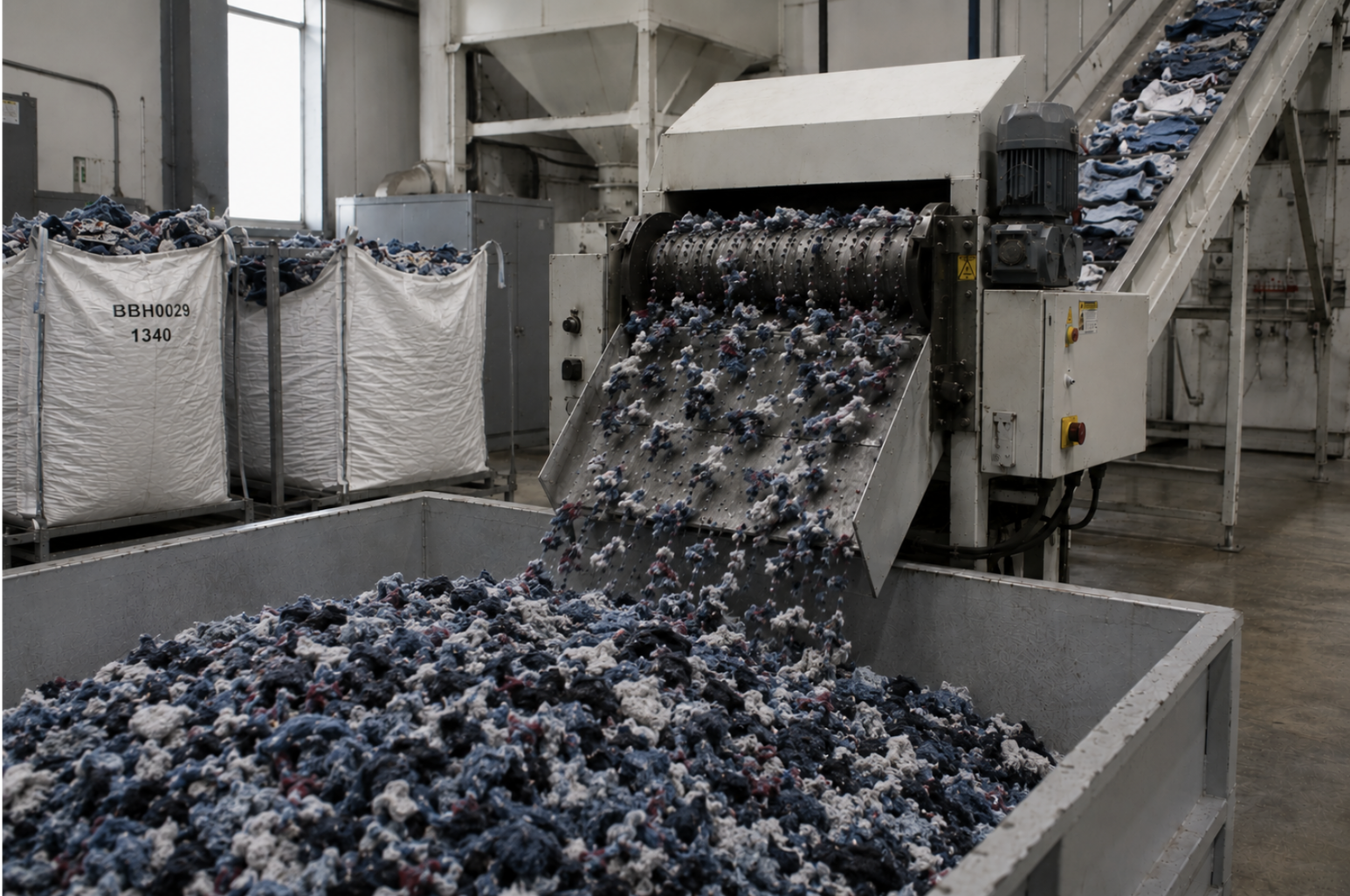
The Cotton Reloop Matrix Project maps and validates what mechanically recycled cotton fibre and yarn can currently deliver against real-world brand specifications, while collaborating with the supply chain to establish a Standard Operating Procedure (SOP) for handling and processing recycled fibres, building the shared, objective view needed to close that gap.

DW(O)R-X
Durable water- and oil-repellent repellency (DW(O)R) finishes are chemical treatments applied to textiles and footwear to keep materials dry, clean, breathable, and durable. Historically, these finishes have relied on per- and polyfluoroalkyl substances (PFAS). However, PFAS are highly persistent, accumulate in the environment and in human bodies, and are associated with harmful health and ecological effects. Increasing regulatory restrictions, combined with brand sustainability commitments and rising consumer awareness, are accelerating the shift toward PFAS-free alternatives.

Sorting for Circularity Rewear
Fashion for Good expanded its Sorting for Circularity framework to address the challenge of sorting for rewearable textiles to understand better their resale potential and the demand across the second-hand market. We launched an 18-month initiative in January 2024 in collaboration with Circle Economy, brand partners adidas, Inditex, Levi Strauss & Co. and Zalando to enhance the sorting of rewearable textiles using innovative AI technologies. The project seeks to improve garment recovery for resale, promoting circularity in the fashion industry.
