
Fiber Club
Fiber Club is an umbrella initiative by Fashion for Good and selected innovators, aimed at enabling faster adoption of next-gen materials, through Innovator specific consortia that provide brands with early and simplified access to an innovator’s materials, secure supply terms, and seamless supply chain integration. By aggregating demand and standardising specifications, the program de-risks innovation for brands and suppliers alike, fostering the market validation necessary for innovators to secure long-term partnerships. Fiber Club aims to not only shift the cost structure but to help align brands in a very fragmented and competitive industry.
What's the challenge?
Brands are facing challenges adopting next-gen materials into their collections at a commercial scale. These challenges stem from several key factors:
- Cost of producing these innovative materials often remains prohibitively high compared to conventional options, making it difficult for brands to maintain competitive pricing and viable profit margins.
- Supply chains for next-gen materials are frequently underdeveloped and inefficient, lacking the established infrastructure and streamlined processes of traditional textile supply chains.
- The research, development, and production lead times associated with novel materials are often considerably longer than those for conventional materials.
- Performance and durability of next-generation materials can present significant technical hurdles, requiring extensive testing and refinement to meet the quality standards and consumer expectations associated with established materials.
Goals of the project
-
1.
Demand Aggregation
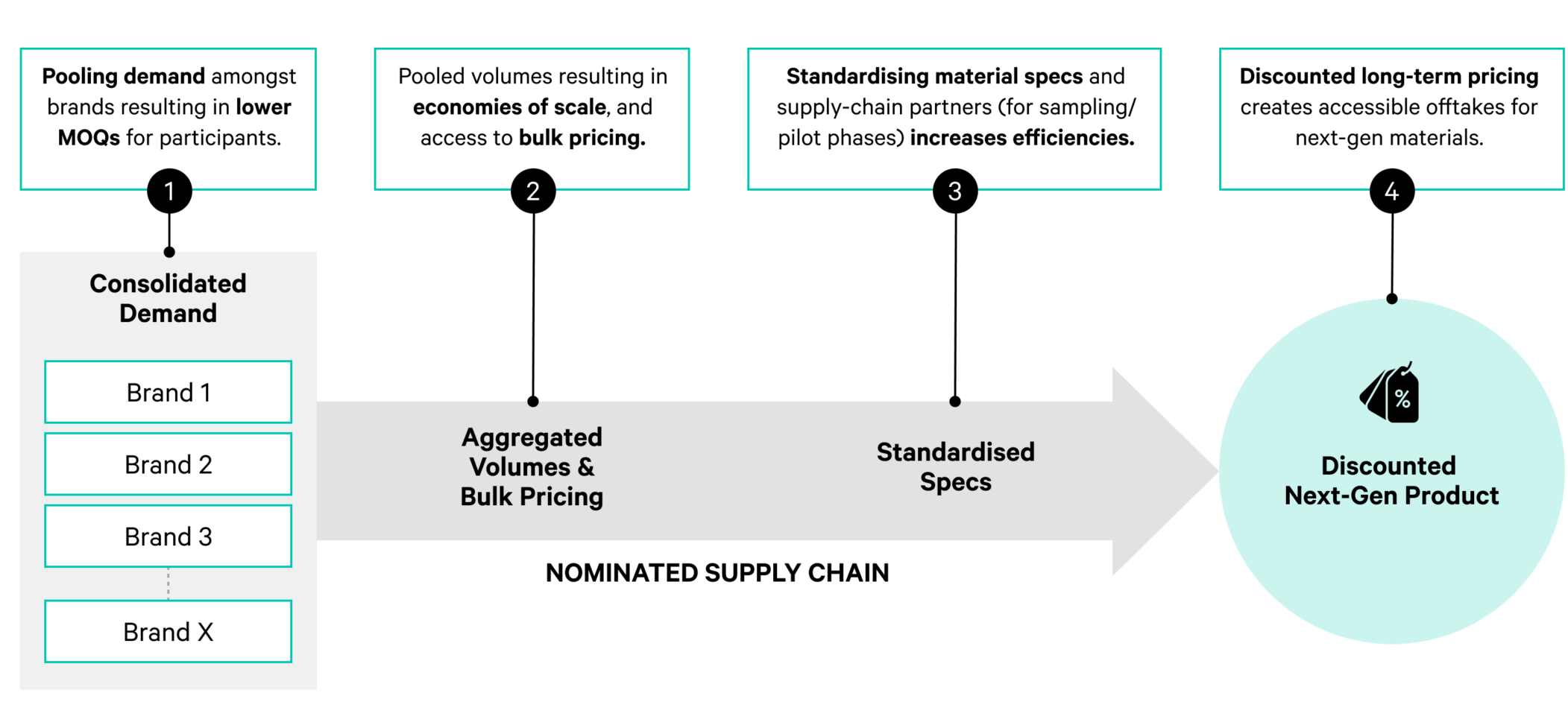
By aggregating fragmented demand into consolidated high-volume orders, lower Minimum Order Quantities (MOQs) are unlocked for participating brands. This centralisation of purchasing power lowers the barrier to entry, enabling brands of all sizes to access next-gen materials that were previously out of reach due to restrictive volume requirements.
-
2.
Reducing Cost Barriers
Pooled volumes unlock economies of scale and access to bulk pricing tiers. This consolidation de-risks the transition from pilot to industry adoption, ensuring next-gen materials can reach cost parity and become economically viable alternatives to conventional materials. -
3.
Standardised Specifications
Validated innovators offer standardised material specifications for sampling and piloting, in collaboration with pre-defined supply chain partners. This streamlined process simplifies the integration of next-gen materials. By sharing learnings, the initiative reduces R&D challenges and timelines.
-
4.
Long-Term Partnerships
Accessible off-take pathways for next-gen materials are created through discounted, long-term pricing structures. By securing demand over extended horizons, innovators are provided with the “bankable” demand needed for industrial expansion while giving brands predictable, reduced costs for long-term material adoption.
Fiber Club Concept
Fiber Club Stages

Fiber Club Structure & Formation
Establish consortium structure and stakeholders involved.

Fiber Club Initial sampling
Brands assess material specs and capabilities, and align on supply terms.

Pilot Collection Development
Develop a pilot collection at individual brand level with innovator material.

Long Term Partnership
Brand to commit to long-term fibre purchase commitment.
Current Fiber Clubs

Circ has cracked the code on recycling poly-cotton blends – the world’s most common fabric – allowing brands to turn old clothes back into high-quality new ones without losing performance.

AltMat turns “trash into treasure” by transforming low-value agricultural waste (like hemp and flax seed stalks) into premium, natural fibres for the global textile market.
Fiber Club Partners


Relevant Resources
In Conversation with Altmat: Natural fibre made from agricultural residue

In Conversation with Circ: The Innovator Turning Textile Waste into New Materials

Journey to Scale: Circ
Unlocking the Trillion-Dollar Fashion Decarbonisation Opportunity
The fashion industry is at a pivotal moment in its journey toward sustainability. With greenhouse gas emissions contributing significantly to global climate change, urgent action is needed to decarbonise supply chains. This report, developed by Fashion for Good in collaboration with the Apparel Impact Institute, outlines existing and innovative solutions to reduce emissions, unlock financing opportunities, and create a pathway to net zero by 2050. Through deep industry insights and financial analysis, this report serves as a guide for brands, manufacturers, policymakers, and investors committed to driving meaningful change.

Financing the Transformation in the Fashion Industry: Unlocking Investment to Scale Innovation
The fashion industry is at a critical juncture. With sustainability commitments and innovation accelerating, the challenge remains in scaling breakthrough solutions. This report, developed by Fashion for Good in collaboration with Boston Consulting Group, delves into the financial mechanisms needed to drive transformation and bring innovative solutions to commercial scale. By addressing key investment barriers and highlighting actionable pathways, this report serves as a call to action for stakeholders across the value chain to collaborate and unlock capital for meaningful impact.

The Great Unlock: closing the innovation commercialisation gap through project finance solutions
The fashion industry stands at a crucial juncture, with innovation paving the way for a more sustainable future. Over the past decade, we have witnessed significant strides in brand commitments, regulatory frameworks, and technological advancements. However, despite these positive trends, scaling these innovations remains a formidable challenge. “The Great Unlock” explores the essential role of project finance as a key enabler in bridging the commercialisation gap, ensuring that groundbreaking solutions can transition from concept to industry-wide implementation.

Fashion for Good And Altmat To Accelerate Adoption of Next-gen Fibres Through Altag® Fiber Club
Other Projects
Sorting for Circularity Rewear
Fashion for Good expanded its Sorting for Circularity framework to address the challenge of sorting for rewearable textiles to understand better their resale potential and the demand across the second-hand market. We launched an 18-month initiative in January 2024 in collaboration with Circle Economy, brand partners adidas, Inditex, Levi Strauss & Co. and Zalando to enhance the sorting of rewearable textiles using innovative AI technologies. The project seeks to improve garment recovery for resale, promoting circularity in the fashion industry.

Behind the Break
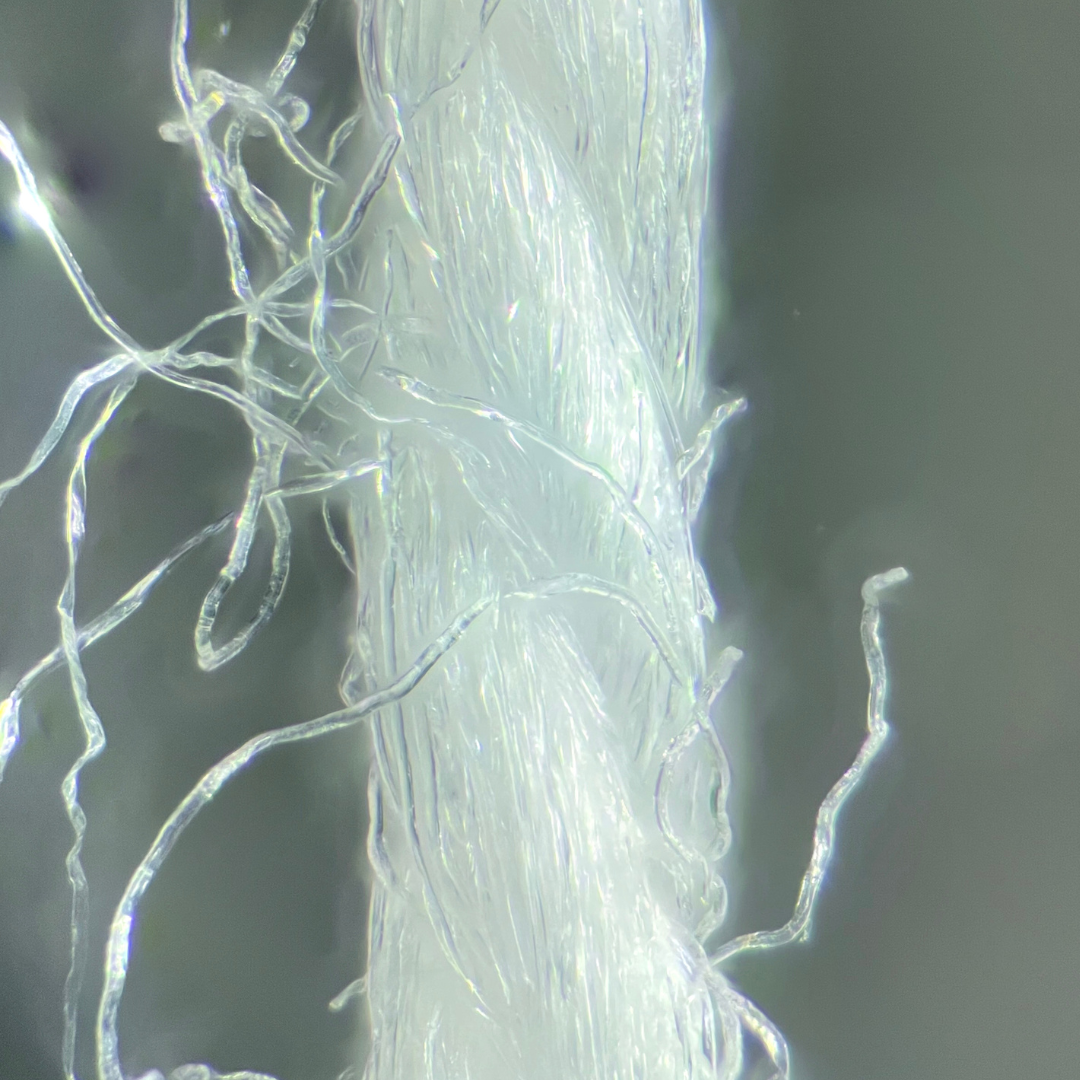
Behind the Break is a multi-phase research initiative developed by Fashion for Good in collaboration with The Microfibre Consortium. The project takes a research-led approach to advance the fashion industry’s understanding of fibre fragmentation, addressing uncertainties in existing testing protocols and key knowledge gaps. By supporting the development of a more credible and consistent foundation, the initiative aims to enable stakeholders to make informed decisions and take decisive action to mitigate fibre fragment pollution, while leveraging the best available science.
Behind the Break 2.0
Behind the Break 2.0 is a targeted research initiative focused on addressing fibre fragmentation in textiles, building directly on the work started in Phase 1.0 (2024–2025), which tested the strengths and limitations of different methods used to measure fibre loss, identifying how much results vary between labs, and exploring what drives fibre shedding across three fabric types: cotton knit, cotton woven, and polyester knit. Phase 2.0 seeks to increase confidence in data quality, consolidate and refine existing testing approaches and knowledge across selected fabric archetypes, and deepen supplier engagement to support wider data collection within the space.
